




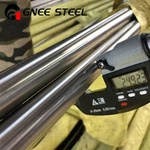

Titanium Alloys
GNEE steel group is a supply chain integrated enterprise including steel plate, coil, profile, outdoor landscape design and processing. Founded in 2008, with 5 million RMB registered capital, Gnee has made impressive progress and development in steel market with Gnee People more than 10 years hard fighting. At present, the total investment amount reaches 30 million RMB, workshop area more than 35000㎡, with over 200 employees. Gnee is becoming the most professional international steel supply chain company in China central plains with explicit strategic framework, integrated governance structure, firm management foundation, abundant fund and human power.
Group has 5 subsidiary corporations, located in Anyang, Tianjin, Hongkong and Singapore countries and districts. Headquarters is in hometown of oracle in Henan province, location of world cultural heritage" Yin Ruin", Anyang city, one of eight ancient capitals of China.
Why Choose Us
High quality
Our products are manufactured or executed to very high standards, using the finest materials and manufacturing processes.
Competitive Price
We offering a higher-quality product or service at an equivalent price. As a result we have a growing and loyal customer base.
Rich experience
Our company has many years of production work experience. The concept of customer-oriented and win-win cooperation makes the company more mature and stronger.
Global shipping
Our products support global shipping and the logistics system is complete, so our customers are all over the world.
After-sale service
Professional and thoughtful after -sales team, let you worry about us after -sales Intimate service, strong after -sales team support.
Advanced equipment
A machine, tool or instrument designed with advanced technology and functionality to perform highly specific tasks with greater precision, efficiency and reliability.


What Is Titanium Alloys?
Titanium alloys are alloys that contain a mixture of titanium and other chemical elements. Such alloys have very high tensile strength and toughness (even at extreme temperatures). They are light in weight, have extraordinary corrosion resistance and the ability to withstand extreme temperatures.
Benefits of Titanium Alloys
High strength: Titanium alloys have high strength-to-weight ratios, making them ideal for applications that require high strength, such as aerospace, automotive, and medical applications.
Lightweight: Titanium alloys are lightweight, which makes them ideal for applications where weight is a concern, such as in aircraft and automobiles.
Corrosion resistance: Titanium alloys are highly resistant to corrosion, making them suitable for use in harsh environments, such as in marine and chemical processing applications.
Biocompatibility: Titanium alloys are non-toxic and non-allergenic, making them ideal for use in medical applications, such as orthopedic implants and dental appliances.
Heat resistance: Titanium alloys have high melting points, making them suitable for use in high-temperature environments, such as in jet engines and industrial furnaces.
Formability: Titanium alloys can be easily formed into complex shapes, making them suitable for use in a variety of applications, such as in the production of medical devices and aerospace components.
There are several types of titanium alloys, each with different properties and uses. Some of the most common types of titanium alloys are.
Alpha alloys
These alloys contain only alpha phase titanium and are soft and ductile. They are used in applications where high formability is required.
Beta alloys
These alloys contain both alpha and beta phases and are stronger and harder than alpha alloys. They are used in applications where high strength is required.
Near-alpha alloys
These alloys contain a higher proportion of alpha phase than beta phase and are similar in properties to alpha alloys.
Alpha-beta alloys
These alloys contain equal proportions of alpha and beta phases and have intermediate properties between alpha and beta alloys.
Commercially pure alloys
These alloys contain at least 99% pure titanium and have low strength but high ductility and corrosion resistance.
Titanium alloy blends
These alloys are blends of different types of titanium alloys, designed to provide a combination of properties suitable for specific applications.
Titanium alloys are used in a wide range of applications due to their unique properties, such as high strength, lightweight, corrosion resistance, and biocompatibility. Some of the most common applications of titanium alloys are.
Aerospace industry: Titanium alloys are widely used in the aerospace industry for the manufacture of aircraft and spacecraft components, such as engine parts, landing gear, and structural components.
Automotive industry: Titanium alloys are used in the automotive industry for high-performance applications, such as in racing cars and supercars, where high strength and lightweight are required.
Medical industry: Titanium alloys are used in the medical industry for the manufacture of orthopedic implants, such as hip and knee replacements, as well as dental appliances and surgical instruments.
Industrial applications: Titanium alloys are used in various industrial applications, such as in the production of chemical processing equipment, power generation equipment, and desalination plants.
Sports equipment: Titanium alloys are used in the manufacture of sports equipment, such as golf clubs, bicycle frames, and fishing rods, due to their lightweight and high strength properties.

The process of manufacturing titanium alloys typically involves the following steps.
Melting
The raw materials, including titanium and alloying elements, are melted together in a furnace to produce a uniform liquid alloy.
Casting
The molten alloy is then poured into a mold to create a casting of the desired shape and size. The casting is allowed to cool and solidify.
Heat treatment
The castings are heated to a specific temperature and held there for a period of time to allow the alloying elements to distribute evenly throughout the material. The heat treatment process can also improve the mechanical properties of the alloy.
Machining
The heat-treated castings are then machined to achieve the final shape and dimensions required for the application. This can involve drilling, milling, turning, and other machining processes.
Finishing
The machined parts are then finished to remove any residual defects or imperfections and to enhance the appearance and surface quality of the parts. This can involve polishing, grinding, and other finishing processes.
How to Maintain Titanium Alloys
Maintaining titanium alloys involves the following steps.
Regular inspections: Regular visual inspections of the titanium alloys can help identify any signs of damage or wear. This can help prevent further damage and ensure that the alloys continue to perform optimally.
Cleaning: Regular cleaning of the alloys can help remove any dirt, grease, or other contaminants that can affect their performance. Use a mild detergent and warm water to clean the alloys, and dry them thoroughly to prevent corrosion.
Lubrication: Titanium alloys that are in motion, such as in machinery or engines, require lubrication to reduce friction and wear. Use a lubricant that is compatible with titanium alloys to ensure that they continue to perform optimally.
Protection from corrosion: Titanium alloys are highly resistant to corrosion, but they can still be affected by certain environments, such as salt water or high humidity. To protect the alloys from corrosion, apply a protective coating, such as paint or varnish, or store them in a dry, protected environment.
Repair: If the titanium alloys are damaged or worn, repair them as soon as possible to prevent further damage. Depending on the severity of the damage, repair may involve replacing a small section of the alloy or completely replacing it.
Choosing the right titanium alloy depends on several factors such as your application's specific requirements, the alloy's properties, and the cost. Here are some steps to help you choose the correct titanium alloy.
Identify your application's requirements: The first step in choosing the correct titanium alloy is to identify your application's specific requirements. Consider factors such as strength, weight, corrosion resistance, and temperature resistance.
Evaluate the titanium alloy's properties: Once you have identified your application's requirements, evaluate the properties of different titanium alloys to determine which one best meets your needs. For example, if your application requires high strength, consider alloy grades such as Ti-6Al-4V or Ti-10V-2Fe-3Al.
Consider the cost: Titanium alloys can be expensive, so it's important to consider the cost when choosing the correct alloy. Determine your budget and select an alloy that meets your application's requirements within that budget.
Consult with a materials expert: If you are unsure which titanium alloy to choose, consult with a materials expert who can provide guidance based on their expertise and experience.
Test the alloy: Before committing to a specific alloy, consider testing a sample to ensure that it meets your application's requirements. This can help prevent any potential issues down the line.
Tips On How To Machine Titanium Alloys Effectively


Use the right tools and equipment
First and foremost, you must ensure that you are using the right tools and equipment for the job. This might sound pretty obvious, but it’s a crucial step in any machining process. Titanium alloys are more difficult to machine due to their increased hardness. Always use high-speed steel tools and carbide-tipped bits when cutting titanium. Steel tools will dull quickly when used on this material, while carbide tips cut cleanly and last longer.
Transmit the generated heat into the chip
One important aspect of efficiently machining titanium is transmitting the generated heat into the chip. This helps to keep the workpiece, the tool, and the coolant fluid at a relatively consistent temperature. The most effective way to do this is to use a horizontal spindle machine for titanium machining.
Another thing you can do to transmit the generated heat into the chip is to increase the feed rate for the part. A higher feed rate can help to keep the temperature consistent during the machining process. This can be especially helpful when machining parts with large feature sizes.
Increase coolant concentration and pressure
As mentioned, titanium alloys have a higher heat conductivity than other metals. Therefore, you should increase the coolant concentration and pressure when machining these materials. Increasing the coolant concentration can help reduce the heat that builds up in the machine. It can also help to keep the workpiece and tool at a relatively consistent temperature, allowing you to increase feed rates for the part.
If you are using a water-based coolant, you can increase the concentration of this fluid by adding an antifoaming agent. A good option for an antifoaming agent is sodium salts, which help increase water’s boiling point and viscosity.
Avoid galling
Titanium alloys typically have a lower lubricity than other metals. This means that they are more likely to gall during machining. Galling is a phenomenon that occurs when two opposing pieces of metal come into contact, and one piece becomes trapped between the two. Galling can cause the machining process to become much more difficult and significantly reduce tool life.
You can help to avoid galling when machining titanium alloys by using a smaller feed rate and a lower spindle speed. In addition, if you are already experiencing galling, you can often fix the problem by increasing the coolant concentration. This can help break the existing gall and allow you to continue the machining process.
What Is the Origin of Titanium?
Titanium was discovered in 1791 by William Gregor, an English chemist, and mineralogist, and named by Martin Heinrich, a German chemist, in 1795. Klaproth named the element “titanium” after the Titans in Greek mythology. However, it wasn’t until 1910 that pure titanium was obtained. M. A. Hunter, a scientist working at Rensselaer Polytechnic Institute, isolated the metal by heating titanium tetrachloride (TiCl4) with sodium at high pressure and temperature (1292-1472 °F), generating pure titanium and sodium chloride as a byproduct. Then, in 1932, William Justin Kroll isolated titanium by reducing TiCl4 through fractional distillation with calcium, and later with magnesium and sodium. Today, the “Kroll Process” is the process frequently used for commercially producing titanium.
How Are Titanium Alloys Tested for Quality?
Titanium alloys are tested for quality through a variety of methods. The most common tests include visual inspection, mechanical testing, and chemical analysis.
Visual inspection: This involves checking the alloy for any visible defects, such as cracks, porosity, or inclusions, which can affect its performance.
Mechanical testing: This test measures the alloy's strength, toughness, hardness, and ductility. It is usually done through tensile testing, fatigue testing, and impact testing.
Chemical analysis: This test checks the alloy's chemical composition to ensure it meets the required specifications. It is done using techniques like spectroscopy.
Non-destructive testing: This type of testing checks the alloy for internal defects without damaging the material. It includes methods like X-ray inspection, ultrasonic testing, and magnetic particle inspection.
Corrosion testing: This test measures the alloy's resistance to various types of corrosive environments.
All these tests are crucial to ensure the quality and performance of the titanium alloy.

Producing titanium alloys comes with several challenges, including.
High cost: The cost of producing titanium alloys is significantly higher than other metals due to the high cost of raw materials and the energy-intensive production process.
Difficult to machine: Titanium alloys are hard and brittle, making them difficult to machine. This can lead to high tool wear and reduce the productivity of the manufacturing process.
Welding challenges: Titanium alloys can be challenging to weld due to their high melting point and susceptibility to contamination, which can weaken the weld and reduce the alloy's performance.
Recycling challenges: Despite the environmental benefits of recycling titanium alloys, the recycling process can be challenging due to the difficulty in separating the alloy from other materials and the high cost of reprocessing the scrap material.
Supply chain challenges: The supply chain for titanium alloys can be complex and challenging to manage due to the limited availability of raw materials and the need for specialized processing equipment.
Despite these challenges, titanium alloys continue to be an important material due to their unique properties and applications in various industries.
Recycling and reusing titanium alloys present a highly beneficial and sustainable approach to mitigate environmental impacts and bolster resource efficiency. Titanium, renowned for its exceptional strength-to-weight ratio, corrosion resistance, and high-temperature stability, is extensively utilized in various industries, including aerospace, medical, and automotive. However, due to its robust nature, recycling titanium can be a complex process that requires innovative methods for efficient recovery.
One such method is hydrometallurgical processes, which are being increasingly adopted to effectively extract titanium from scrap materials. These processes involve the use of chemical solutions to dissolve the titanium, allowing for its separation and subsequent reuse. By implementing these innovative techniques, we not only conserve natural resources but also reduce the energy-intensive process of extracting titanium from ores.
As we continue to push for sustainability in the metals industry, the recycling and reuse of titanium alloys have become more crucial than ever. This not only contributes to minimizing waste and reducing the carbon footprint but also promotes a circular economy where valuable resources are kept in use for as long as possible. By embracing the recycling and reusing of titanium, we can make significant strides towards a more sustainable and environmentally friendly future.

As consumer electronics progress towards higher performance, titanium alloy use will likely proliferate. Its high strength and low density allow for reduced thickness and weight without compromising robustness. Looking ahead, structural applications of titanium alloy will grow across device categories like tablets, laptops and additional smartphone components.
Advances in 3D printing are overcoming titanium alloy processing challenges. As the technology, costs, and properties of additive techniques continue to develop in accordance with manufacturer needs, their adoption will accelerate. 3D printing shows strong potential to expand titanium integration within consumer electronics by addressing manufacturing barriers and realizing optimized, yet economical designs across a broad range of scales.
Our Factory
Gnee is becoming the most professional international steel supply chain company in China central plains with explicit strategic framework, integrated governance structure, firm management foundation, abundant fund and human power.


FAQ
Q: What is titanium alloy made of?
Q: What is the strongest form of titanium alloy?
Q: What is the difference between titanium and titanium alloy?
Q: Is titanium alloy expensive?
Q: Can titanium alloy stop a bullet?
Q: Which titanium alloy is bulletproof?
The Ti-6Al-4V alloy provides superior ballistic protection when compared on a weight basis to conventional rolled homogeneous armor (RHA) steel, but it is far less efficient on both a weight and volume basis than state-of-the-art ceramic armor. Armor materials can be compared by their mass efficiency rating, Em.
Q: Why is titanium so difficult to weld?
Q: Why not make guns out of titanium?
Q: Is titanium stronger than diamond?
Q: Is kevlar stronger than titanium?
Q: Does gold make titanium stronger?
Q: Why does titanium not rust?
Q: Why is titanium hard to cut?
Q: What's stronger than titanium?
As mentioned above, tungsten is the strongest of any natural metal (142,000 psi). But in terms of impact strength, tungsten is weak — it's a brittle metal known to shatter on impact. On the other hand, Titanium has a tensile strength of 63,000 psi.
Q: Is titanium flammable?
Q: Is titanium valuable scrap?
Q: Why are there no titanium swords?
Q: How much titanium is needed to stop a bullet?
Q: Are titanium bullets real?
Q: Is titanium magnetic or not?