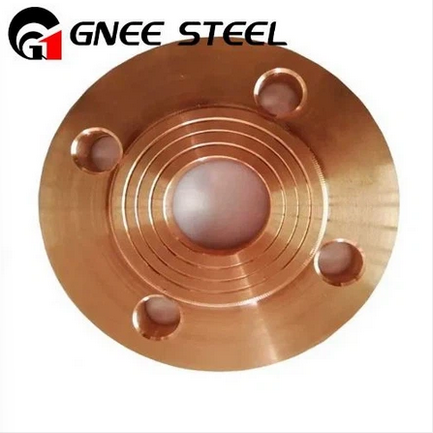
1. C70600 flanges are the standard for seawater piping systems. What is the specific mechanism by which the 10% Nickel content fundamentally changes the corrosion behavior of copper to make it resistant to impingement attack in high-velocity seawater?
The addition of 10% Nickel induces a transformative change in the nature and tenacity of the alloy's protective surface film.
Pure Copper's Vulnerability: Copper relies on a Cu₂O (cuprous oxide) layer, which, while protective in quiet waters, is soft and can be mechanically scoured away by high-velocity, turbulent water containing sand or air bubbles. This leads to rapid impingement attack.
The C70600 Mechanism: A Superior Passive Film
The nickel modifies the oxide layer in two key ways:
Enhanced Cation Selectivity: Nickel promotes the formation of a complex, thin, and highly adherent layer primarily composed of Cu₂O, but enriched with nickel oxide (NiO) at the metal-oxide interface. This nickel-rich sub-layer is highly protective and acts as a superior barrier.
Film Reformation and Self-Repair: More importantly, nickel drastically improves the film's ability to self-repair. In the event of a minor mechanical damage (e.g., from a sand particle), the presence of nickel catalyzes the rapid re-passivation of the exposed surface. The film reforms almost instantaneously, preventing the localized corrosion from propagating into a pit or groove.
This robust and self-healing film is the reason C70600 flanges can withstand seawater velocities in excess of 4 m/s, making them ideal for pump discharge lines, firewater systems, and other high-flow applications where copper or Admiralty brass would rapidly fail.
2. In a complex seawater pipework assembly, flanges made from C70600 will be connected to pipes of the same alloy. However, they may also be bolted to valves or equipment made of different materials like Super Duplex Stainless Steel. What is the primary galvanic corrosion risk in this scenario, and what two specific design measures are taken to mitigate it?
The primary risk is that the C70600 will act as the anode in the galvanic couple, leading to its accelerated corrosion.
The Galvanic Series: In seawater, the corrosion potential of metals is relatively fixed. Super Duplex Stainless Steel (e.g., UNS S32750) is highly noble (cathodic) due to its robust passive film. C70600, while corrosion-resistant, is less noble (anodic). When electrically connected in an electrolyte (seawater), electrons flow from the C70600 (anode) to the Super Duplex (cathode), causing the C70600 to corrode.
Mitigation Measures:
Electrical Isolation (Dielectric Isolation): This is the most effective method. Insulating Gasket Kits are installed between the flanges. These kits include non-conductive gaskets (e.g., PTFE, rubber-lined) and sleeves and washers that isolate the bolts from one flange, thereby breaking the electrical continuity of the circuit. This prevents the galvanic current from flowing.
Cathodic Protection: For systems where isolation is impractical, the entire system can be protected by making it the cathode. This is achieved by connecting it to a more anodic material (a sacrificial anode), such as zinc or aluminum anodes bolted to the pipework. The protective current from the anode suppresses the corrosion of the C70600, effectively making it cathodic relative to the anode.
Using both isolation and a protective coating on the C70600 flange faces provides a robust, multi-layered defense against galvanic corrosion.
3. The successful welding of a C70600 flange to a C70600 pipe is critical for system integrity. What is the single most important characteristic of the filler metal that must be used, and what specific microstructure in the weld metal does this promote to prevent preferential corrosion?
The single most important characteristic is that the filler metal must be over-alloyed with a stronger nitride former than copper.
The Problem: Weld Metal Preferential Corrosion
Standard C70600 filler metal (e.g., ERCuNi) has a similar composition to the base metal. During welding, the intense heat can cause the nickel and iron in the weld metal to oxidize, leaving it slightly depleted in these critical elements. More critically, if the weld metal solidifies with a cored structure, the interdendritic regions can be enriched in copper. In seawater, this micro-segregation can set up micro-galvanic cells, making the copper-rich areas anodic and leading to selective attack of the weld bead.
The Solution: Niobium-Stabilized Filler Metal
The standard and correct filler metal for welding C70600 is ERCuNi (according to AWS A5.7), which typically contains an addition of 1.0-2.0% Niobium (Nb).
Niobium's Role: Niobium is a powerful nitride and carbide former. It has a much stronger affinity for nitrogen (a common impurity) than copper or nickel. By forming stable niobium nitrides/carbides, it prevents the formation of undesirable copper nitrides, which are corrosive.
Resulting Microstructure: The niobium promotes a finer, more homogeneous as-cast microstructure in the weld metal by reducing segregation. This creates a more electrochemically uniform surface, eliminating the anodic pathways that lead to preferential weld corrosion.
Using the correct niobium-modified filler metal is non-negotiable for creating a weldment whose corrosion resistance matches that of the C70600 base metal.
4. For a large-diameter, high-pressure seawater system on an FPSO (Floating Production Storage and Offloading vessel), a C70600 flange would be a massive and expensive forging. What key property, beyond corrosion resistance, justifies its use over a less expensive, coated carbon steel flange in this dynamic, weight-sensitive environment?
The key justifying property is superior resistance to Biofouling.
An FPSO is a long-term asset stationed in one location for years, creating a perfect environment for marine organisms (barnacles, mussels, algae, tubeworms) to colonize submerged structures-a process known as biofouling.
Coated Carbon Steel Flange:
The coating is a temporary barrier. Once damaged (by impact, abrasion, or UV degradation), the underlying steel is exposed.
Biofouling will readily adhere to the coating and the exposed steel. The organisms' metabolic activity and the physical presence of the fouling create a corrosive, oxygen-depleted microenvironment under the fouling, accelerating localized corrosion.
The increased drag and weight from heavy fouling are significant operational penalties.
Requires frequent, costly, and hazardous in-water inspections and cleaning.
C70600 Flange:
Copper ions slowly leach from the alloy's surface in seawater. These ions are toxic to the larval and spore stages of most marine fouling organisms.
This creates a "anti-fouling" zone around the flange, preventing the settlement and growth of macro-fouling. The surface may develop a sliming microfilm, but it will not support hard fouling.
This provides a maintenance-free, permanent solution that eliminates the cost, risk, and downtime associated with fouling control on a critical seawater intake or discharge system.
For an FPSO, where dry-docking for maintenance is a multi-million dollar event, the lifetime biofouling resistance of C70600 provides an unparalleled economic and operational advantage.
5. During the installation of a C70600 flange, the gasket selection is critical. Why are non-absorbent, non-conductive gasket materials like reinforced PTFE or rubber-lined types preferred over compressed non-asbestos (CNAF) gaskets for long-term seawater service?
The gasket selection is driven by the need to prevent Crevice Corrosion and Galvanic Corrosion.
Crevice Corrosion Risk:
CNAF Gaskets: These are cellulose-based and are absorbent. They can wick seawater into their fibrous structure, creating a persistent, trapped electrolyte within the flange crevice. The stagnant seawater inside the crevice can become deoxygenated and acidic, potentially challenging the protective film on the C70600 and initiating crevice corrosion over time.
PTFE/Rubber-Lined Gaskets: These materials are non-absorbent and chemically inert. They do not retain moisture, effectively sealing the flange face and preventing the creation of a persistent, corrosive crevice environment.
Galvanic Corrosion Risk:
If the flange is connected to a different material (e.g., a titanium valve or steel pump), using a conductive gasket would create a direct electrical path, exacerbating galvanic corrosion as discussed earlier.
PTFE and rubber are excellent electrical insulators. When used as part of an insulating gasket kit, they break the electrical circuit between the two flanges, providing crucial protection against galvanic attack.
Therefore, while CNAF gaskets are suitable for many services, for the critical, permanent, and corrosive environment of a seawater system, the inert and non-conductive nature of PTFE or rubber-lined gaskets provides a far more reliable and durable seal, ensuring the long-term integrity of the C70600 flange connection.