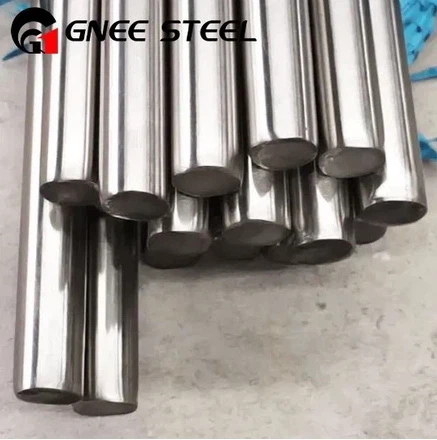
Grade 3 titanium is a type of commercially pure titanium (CP titanium), classified as the third-highest strength variant among the four common CP titanium grades (Grades 1, 2, 3, and 4). It is a non-alloyed titanium material, meaning its composition is primarily pure titanium (≥99.0%) with controlled trace impurities (such as oxygen, iron, carbon, nitrogen, and hydrogen).
Unlike titanium alloys (e.g., Ti-6Al-4V), Grade 3 does not contain intentional alloying elements (e.g., aluminum, vanadium). Its key characteristics lie in a balanced combination of moderate strength (higher than Grades 1 and 2 but lower than Grade 4), good corrosion resistance (comparable to other CP titanium grades), and adequate formability (though slightly less ductile than Grades 1 and 2 due to higher oxygen content). It is widely used in industries where strength requirements exceed those of lower-grade CP titanium but do not necessitate the use of more expensive titanium alloys.
Grade 3 titanium exhibits moderate mechanical strength, positioning it between the lower-strength Grades 1/2 and the highest-strength Grade 4 among commercially pure titanium. Its strength is primarily derived from controlled oxygen content (a key impurity that acts as a strengthener in CP titanium), and its typical mechanical properties (in the annealed state, per standards like ASTM B265) are as follows:
Yield Strength: Approximately 380–480 megapascals (MPa) or 55,000–70,000 pounds per square inch (psi). This refers to the stress at which the material begins to undergo permanent deformation, a critical 指标 for structural or load-bearing applications.
Tensile Strength: Approximately 480–620 MPa or 70,000–90,000 psi. This is the maximum stress the material can withstand before breaking under tension.
Ductility: Elongation at break of around 12%–20%. While its strength is higher than Grades 1 and 2, it still retains sufficient ductility for common fabrication processes like bending, welding, and machining-though it may require slightly more force than lower-grade CP titanium during forming.
In practical terms, Grade 3's strength is suitable for applications where moderate load-bearing capacity is needed, such as chemical processing equipment or lightweight structural components, without sacrificing the corrosion resistance inherent to pure titanium.
Grade 3 titanium is a commercially pure titanium grade, so its composition is dominated by titanium (as the base metal) with strictly controlled trace impurities (no intentional alloying elements). The typical chemical composition (by weight, per international standards like ASTM B265, ASTM F67, or ISO 5832-1) is as follows:
This composition ensures Grade 3 retains the corrosion resistance of pure titanium while achieving moderate strength through controlled oxygen levels.
The tensile strength of Grade 3 titanium is defined as the maximum stress the material can withstand before fracturing under tensile (pulling) forces. Its tensile strength is standardized across industry specifications (e.g., ASTM B265 for titanium plates/sheets, ASTM B338 for titanium pipes/tubes) and is typically measured in the annealed state (the most common condition for CP titanium, as annealing optimizes ductility and stability).
Typical Tensile Strength Range: 480–620 megapascals (MPa) or equivalently 70,000–90,000 pounds per square inch (psi).
Key Notes:
Annealed vs. Cold-Worked States: While annealed Grade 3 has the tensile strength range above, cold-working (e.g., rolling, drawing) can increase its tensile strength by 10–20% (e.g., up to ~680 MPa / 98,000 psi). However, cold-working reduces ductility, so it is only used for specific applications requiring higher strength.
Standard Consistency: Major standards (ASTM, ISO) specify a minimum tensile strength of 480 MPa (70,000 psi) for Grade 3, ensuring consistency across manufacturers. The upper limit (620 MPa / 90,000 psi) reflects typical production variability while maintaining ductility (elongation ≥12%).
This tensile strength makes Grade 3 suitable for applications like chemical process equipment, heat exchangers, and lightweight structural parts-where it can withstand moderate tensile loads without failing, while retaining corrosion resistance.