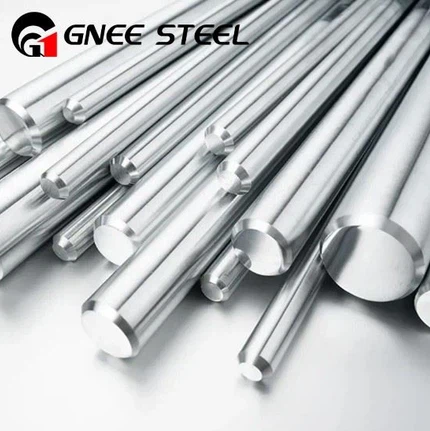
1. Q&A: Nickel Round Bar vs. Nickel Alloy Bar
Q: I am sourcing material for a series of support bolts in a chemical storage tank. My supplier offers both "Nickel Round Bar" and "Nickel Alloy Round Bar" at different price points. Is Nickel Round Bar always the better, purer choice, or are there applications where the alloy version is actually superior?
A: This is a common point of confusion, but understanding the distinction is critical for proper material selection. The terms refer to fundamentally different categories of material, and neither is universally "better"-they are designed for different jobs.
Nickel Round Bar (such as Nickel 200 or 201) refers to a solid bar stock made from commercially pure nickel. As we discussed in the previous context, this means a minimum of 99.6% nickel content. Its corrosion resistance comes directly from the inherent properties of nickel itself.
Nickel Alloy Round Bar refers to bars made from alloys where nickel is the primary element but is intentionally combined with significant percentages of other elements like chromium, molybdenum, copper, or iron. Common examples include:
Monel 400 (Nickel-Copper alloy)
Inconel 600 (Nickel-Chromium alloy)
Hastelloy C-276 (Nickel-Molybdenum-Chromium alloy)
So, which is superior? It depends entirely on the environment:
For your support bolts in a chemical storage tank: If the tank contains caustic soda (sodium hydroxide) , the pure Nickel Round Bar (Nickel 200) is likely superior. Its resistance to caustic environments is exceptional. However, if the tank contains hydrochloric acid or a strongly reducing acid, a Nickel-Molybdenum alloy like Hastelloy would vastly outperform pure nickel.
For high-temperature oxidation resistance: If the bolts need to withstand high heat, a Nickel-Chromium alloy like Inconel 600, which forms a protective chromium oxide scale, would be the superior choice. Pure nickel would oxidize and scale rapidly.
For strength: Nickel alloy round bars are almost always stronger. Pure nickel round bar is relatively soft. If the bolts require high clamping forces, you may need the mechanical strength of a precipitation-hardenable nickel alloy.
In summary, do not assume "pure" means "best." Match the material's chemistry to the specific chemical and thermal environment. For many aggressive environments, the alloyed versions are engineered to provide superior performance.
2. Q&A: Manufacturing Methods: Hot-Rolled vs. Cold-Finished Nickel Round Bar
Q: Our machine shop is about to produce a large batch of precision fittings from Nickel 200 round bar. The material spec allows for both hot-rolled and cold-finished bar stock. What are the practical differences in machinability, dimensional accuracy, and cost that we should consider before placing our order?
A: Choosing between hot-rolled and cold-finished bar is a classic manufacturing decision that directly impacts your production efficiency and part quality. Here is how the two forms differ for Nickel 200:
Hot-Rolled (HR) Bar:
Manufacturing: Produced by heating a billet above its recrystallization temperature and passing it through rolling dies to achieve the approximate desired diameter.
Surface Finish: Has a rough, scaly surface (mill scale) that must be removed, usually by machining or abrasive cleaning, before use.
Dimensional Tolerance: Has relatively loose dimensional tolerances (e.g., ASTM B160 allows for significant diameter variations). The bar may also be slightly out-of-round.
Machinability: The inconsistent surface and potential for slight dimensional variations can make it more challenging to hold tight tolerances in automatic lathes. It requires a heavier initial cut to get "under the scale" and to a true diameter.
Cost: Generally less expensive per pound than cold-finished bar due to the simpler manufacturing process.
Cold-Finished (CF) Bar:
Manufacturing: Starts as a hot-rolled bar that is then processed at room temperature, typically by cold drawing (pulling through a die) or centerless grinding.
Surface Finish: Has a smooth, bright, scale-free surface. For many applications, this surface is acceptable as-is or requires minimal polishing.
Dimensional Tolerance: Held to much tighter tolerances (often to half of the HR tolerance or better) and is consistently straight and round.
Machinability: The consistent diameter and smooth surface allow for easier setup, faster machining cycles, and better surface finish on the final part. It is the preferred choice for high-volume screw machine operations.
Cost: Commands a premium price due to the additional processing steps and tighter controls.
Recommendation for your precision fittings: If your tolerances are tight and you are running a high-volume production, the extra cost of cold-finished round bar will likely be offset by reduced scrap rates, faster cycle times, and less tool wear. If the parts are large, have very loose tolerances, and will be heavily machined all over, hot-rolled could be a cost-effective starting point.
3. Q&A: Heat Treatment of Nickel Round Bar Components
Q: We are machining complex valve stems from Nickel 200 round bar. After machining, some parts are slightly warped, and we are concerned about residual stresses causing failure in service. Can we heat-treat these parts to relieve stress, and if so, what is the correct process?
A: Yes, you can and should perform a stress-relieving heat treatment on machined Nickel 200 components, especially complex ones like valve stems. Machining removes material unevenly, which releases the inherent residual stresses in the bar stock in a non-uniform way, leading to the warping you are observing.
However, you must be extremely careful with the temperature. This is a critical point where Nickel 200 differs from steel.
The Correct Process: Stress Relieving
Temperature Range: For Nickel 200, stress relieving is typically performed between 425°C and 650°C (800°F – 1200°F) .
Soak Time: Hold the parts at this temperature for one hour per inch of cross-section.
Cooling: After soaking, cool slowly in the furnace or in still air. Avoid rapid cooling (quenching), as this can introduce new thermal stresses.
The Critical Warning: Do Not Exceed 650°C (1200°F)
You must ensure your furnace is calibrated and does not overshoot this temperature. If the stress-relieving temperature approaches or exceeds 700°C (1300°F) for Nickel 200 (with its standard carbon content), you risk entering the graphitization range.
As we discussed with Nickel 200 vs. 201, prolonged exposure above 315°C begins the process, but at these higher stress-relieving temperatures, the risk is immediate and severe. The carbon will precipitate as graphite at the grain boundaries, rendering the valve stem brittle and unusable.
Alternative for High-Temperature Concerns:
If your heat treater cannot guarantee precise temperature control below 650°C, you have two options:
Use Nickel 201: Specify your next order of round bar as Nickel 201 (low carbon). It can be stress-relieved at higher temperatures (up to 750°C) without the risk of graphitization.
Mechanical Stress Relief: For simple parts, consider vibratory stress relief as a non-thermal alternative.
For your current batch of Nickel 200 valve stems, a controlled stress relief at 540°C (1000°F) for the appropriate time should alleviate the warping and stabilize the parts without damaging the material.
4. Q&A: Sourcing Large Diameter Nickel Round Bar
Q: We are designing a large flanged nozzle for a high-pressure caustic reactor. Our design calls for a 12-inch diameter flange made from Nickel 200. When I contact suppliers, some offer "rolled ring" forgings and others offer "bar stock." What is the practical difference, and which is technically correct for a flange?
A: This is an excellent question that gets to the heart of material sourcing and metallurgical structure. For a 12-inch diameter component like a flange, you are unlikely to find a solid round bar of that size that is both available and cost-effective. You are entering the realm of "semi-finished" products, and the distinction between large bar and rolled rings is important.
Solid Round Bar (Large Diameter):
Manufacturing: This is a solid, cylindrical piece. In very large diameters (e.g., 8" to 12"+), it is typically produced by hot forging or hot rolling a large ingot down to the final diameter.
Grain Flow: The grain flow is oriented longitudinally along the length of the bar.
Availability: Truly large diameter bar stock is less common and may have long lead times. It also results in a significant amount of material being machined away (becoming chips/scrap) to create the flange profile.
Cost: The material cost is high, and the machining cost is very high due to the volume of metal removed.
Rolled Ring Forgings:
Manufacturing: This is a specialized forging process. A short, thick-walled hollow "preform" is heated and placed on a ring rolling mill. A mandrel presses from the inside against an outer drive roll, progressively squeezing and rolling the wall thinner while the diameter expands until the final size and shape are achieved.
Grain Flow: This process creates a grain flow that is circumferential, following the shape of the ring. For a flange, this is the ideal grain orientation, as the primary stresses in a pressurized flange are hoop stresses (circumferential).
Material Efficiency: A rolled ring is forged much closer to the final shape of a flange. You start with a ring that already has a hole in the middle, dramatically reducing the amount of material that ends up as scrap chips.
Industry Standard: For large flanges, especially in high-pressure or critical service, rolled ring forgings are the industry standard. They offer superior mechanical properties due to the optimized grain flow and are more economical in large sizes.
Conclusion for your project: While technically you could machine your 12" flange from a massive solid bar, it would be technically inferior (wrong grain orientation) and economically wasteful. The correct and more practical choice is to source a Nickel 200 rolled ring forging produced to ASTM B564 (the standard for forged nickel alloy flanges). This will give you a better component, faster delivery, and lower total cost.
5. Q&A: NDT and Testing of Nickel Round Bar
Q: We are using Nickel 201 round bar to manufacture critical fasteners for a nuclear power plant cooling system. The specification requires us to perform non-destructive testing on the bar stock before machining. What are the standard NDT methods for nickel alloy bar, and what defects are they looking for?
A: For nuclear and other high-integrity applications, testing the raw material is non-negotiable. The goal is to identify internal or surface defects in the round bar that could compromise the finished fastener's performance under stress. For nickel alloy bar stock, the two most common NDT methods are Ultrasonic Testing and Eddy Current Testing, often used in conjunction.
1. Ultrasonic Testing (UT) - For Internal Soundness:
This is the primary method for detecting internal flaws.
How it works: A high-frequency sound wave is transmitted into the bar. The sound wave travels through the material and reflects off the back wall. If the wave encounters a discontinuity (like a crack, inclusion, or void) on its path, a portion of the sound energy reflects back to the transducer earlier than the main back-wall echo. This "indication" is analyzed to determine the size, depth, and location of the flaw.
What it looks for: Internal pipe (shrinkage cavities from casting), large non-metallic inclusions, centerline porosity, and internal cracking.
Standards: Typically performed to ASTM E213 or similar.
2. Eddy Current Testing (ECT) - For Surface and Near-Surface Defects:
This method is excellent for detecting defects that could act as stress concentrators on the surface of the final fastener.
How it works: A probe containing a coil carrying an alternating current is passed around or along the bar. This creates a changing magnetic field that induces "eddy currents" in the bar. Defects or changes in the material (like a seam or crack) disrupt the flow of these eddy currents, which is detected by the probe.
What it looks for: Surface seams (longitudinal folds), laps, cracks, and scratches. It can also detect near-surface defects.
Standards: Typically performed to ASTM E309 or ASTM E571.
Additional Testing for Nuclear Applications:
Given your nuclear application, you can also expect to see:
PMI (Positive Material Identification): To verify the low-carbon chemistry of Nickel 201 before machining.
Dimensional Inspection: To confirm the bar meets the tight tolerances required for automatic fastener manufacturing.
Liquid Penetrant Testing (PT): Sometimes used as an additional surface check on the machined fasteners, but for raw bar stock, ECT is faster and more automated.
When you order, ensure your purchase order explicitly calls out the required NDT standards (e.g., "Ultrasonic testing per ASTM E213, Level 1 acceptance criteria"). The supplier will then provide a report certifying that the bar stock has passed these rigorous inspections before it ever reaches your machine shop floor.