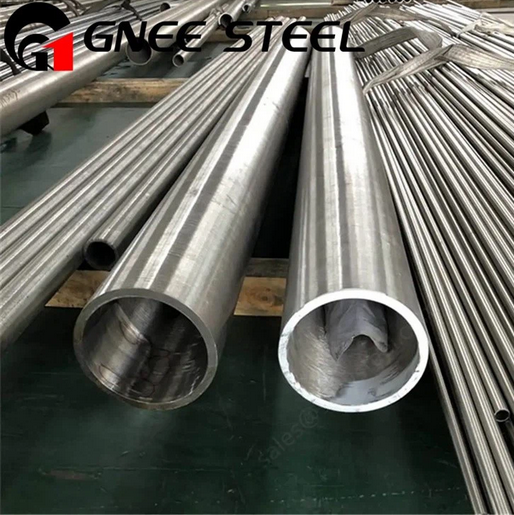
1. The power generation industry is extremely demanding. For what specific high-temperature, high-pressure applications is ASTM B514 Incoloy 800H Welded Pipe specifically designed and qualified?
ASTM B514 Incoloy 800H (UNS N08810) welded pipe is engineered for large-diameter, high-pressure, high-temperature piping systems in power generation where seamless pipe is either unavailable in the required size or economically prohibitive, yet performance cannot be compromised. Its design and qualification are targeted at the "balance-of-plant" (BOP) systems in advanced thermal power plants.
Key Power Generation Applications:
Main Steam & Hot Reheat Piping: In supercritical and ultra-supercritical (USC) coal-fired power plants, steam temperatures can exceed 593°C (1100°F) and pressures surpass 24 MPa (3500 psi). Incoloy 800H offers superior creep strength and oxidation resistance compared to standard ferritic or austenitic steels in this critical temperature range (593-760°C / 1100-1400°F). B514 welded pipe allows for the fabrication of large-diameter headers and manifolds that route this superheated steam from the boiler to the high-pressure turbine.
Advanced Heat Recovery Steam Generator (HRSG) Piping in Combined Cycle Plants: Modern HRSGs in gas turbine combined-cycle (GTCC) plants operate at increasingly high temperatures to boost efficiency. The high-pressure evaporator and superheater sections, especially in the first (hottest) rows facing the gas turbine exhaust, may utilize Incoloy 800H welded pipe for its ability to withstand high metal temperatures and thermal fatigue from frequent cycling (start-ups and shut-downs).
Steam Bypass and Attemperator Lines: These critical safety and control systems handle steam at or near main steam conditions and are subject to severe thermal shock. The high-temperature strength and toughness of Incoloy 800H make it suitable for these demanding services.
Advanced Nuclear Power Systems: In some Generation IV reactor designs, such as supercritical water-cooled reactors (SCWRs) or high-temperature gas-cooled reactors (HTGRs), Incoloy 800H is a candidate material for intermediate heat exchangers and associated piping, where its properties under neutron irradiation are also considered.
Why Welded (B514) vs. Seamless: For large-diameter pipes (e.g., NPS 24 and above) required for main steam lines, seamless manufacturing is not feasible or is exorbitantly expensive. ASTM B514 governs the production of welded pipe from plate or sheet, which is then solution annealed and cold worked (if specified) to achieve properties approaching those of seamless product. This provides a cost-effective and technically sound solution for large-scale, high-energy piping systems.
2. ASTM B514 is a unique standard for "welded, unannealed" corrosion-resistant nickel alloy pipe. What are the critical mechanical property and dimensional requirements it imposes on Incoloy 800H pipe, and how do they differ from a seamless pipe specification like ASTM B407?
ASTM B514, Standard Specification for Welded, Unannealed Nickel and Nickel-Alloy Pipe, is distinctly different from specifications for annealed seamless or welded-annealed pipe. Its focus is on as-welded, cold-worked pipe for high-strength applications.
Critical Requirements of ASTM B514 for Incoloy 800H:
Condition: The pipe is supplied in the "as-welded" condition. The weld and base metal are not solution annealed after the final forming and welding operation. This is a key differentiator.
Cold Work Requirement: To achieve the required strength, the pipe is subjected to a cold reduction (cold working) of the weld and base metal after welding. The standard specifies a minimum cold reduction of 10% of the wall thickness. This cold work significantly increases the yield and tensile strength.
Mechanical Properties (For Incoloy 800H per B514):
Tensile Strength: ≥ 655 MPa (95 ksi)
Yield Strength (0.2% Offset): ≥ 310 MPa (45 ksi)
These values are substantially higher than the annealed condition (e.g., in B407, annealed 800H yield strength is typically ~207 MPa / 30 ksi). This high strength in the as-welded, cold-worked state is a primary reason for selecting B514 pipe.
Comparison with Seamless Specification ASTM B407:
| Aspect | ASTM B514 (Welded, Unannealed, Cold Worked) | ASTM B407 (Seamless, Annealed) |
|---|---|---|
| Primary Condition | As-welded + Cold worked. Not annealed. | Solution annealed to a coarse grain structure (for 800H). |
| Key Purpose | High strength in the as-supplied state for large-diameter pressure pipe. | Optimized high-temperature creep strength and corrosion resistance. |
| Yield Strength | High (≥ 310 MPa). Derived from cold work. | Lower (~207 MPa). Optimized for creep, not room-temperature yield. |
| High-Temp Creep Strength | The cold-worked structure is not stable at high temperature. It will recrystallize and soften upon exposure to service temperatures, eventually approaching annealed properties. The initial high strength is for handling/construction. | The annealed, coarse-grain structure is stable and designed explicitly for long-term creep strength at temperature. This is its primary engineering property. |
| Weld Inspection | Requires rigorous nondestructive examination of the longitudinal weld seam (per B514). | No longitudinal weld seam to inspect. |
| Grain Size Requirement | No requirement for coarse grain size. | Mandatory requirement for ASTM No. 5 or coarser grain size for 800H. |
Crucial Engineering Note: The high yield strength of B514 pipe is beneficial for handling, fabrication, and supporting the pipe during construction before it goes into hot service. Once in service at high temperature (e.g., >600°C), the cold-worked structure will thermally recover. Therefore, design for high-temperature creep must be based on the annealed material properties (e.g., from ASME Section II, Part D for SA-376 or similar), not on the room-temperature yield strength from the B514 test report.
3. In power plant construction, the longitudinal weld seam is a focal point for quality assurance. What specific weld geometry, process, and non-destructive examination (NDE) requirements does ASTM B514 mandate to ensure the integrity of Incoloy 800H welded pipe?
Given that the pipe is used in high-energy systems, the integrity of the longitudinal weld seam is paramount. ASTM B514 enforces rigorous controls from welding through inspection.
Weld Geometry and Process:
Welding Process: The longitudinal seam is typically made using automatic welding processes that ensure consistency. Common processes include:
Gas Tungsten Arc Welding (GTAW) for the root pass, often followed by...
Gas Metal Arc Welding (GMAW) or Submerged Arc Welding (SAW) for fill and cap passes. The use of SAW is common for thick-walled power plant pipe.
Filler Metal: Must be of a composition suitable for producing weld metal that meets the mechanical property requirements of the specification. For Incoloy 800H, this is typically a matching nickel-chromium-iron filler (e.g., ERNiFeCr-1).
Weld Reinforcement: The standard permits weld reinforcement (both internal and external) but limits its height to ensure smooth transitions and facilitate NDE. The weld must be free of cracks, lack of fusion, and excessive undercut.
Mandatory Non-Destructive Examination (NDE) per ASTM B514:
The specification requires 100% nondestructive examination of the longitudinal weld seam. The permissible methods and their sequences are strictly defined:
Radiographic Examination (RT): This is the primary and mandatory examination method.
Standard: Performed in accordance with ASTM E94 (Guide for Radiographic Examination) and ASTM E142 (Method for Controlling Quality of Radiographic Testing).
Acceptance Criteria: Defects are evaluated against ASTM E390, Reference Radiographs for Steel Fusion Welds. For this high-integrity application, the acceptance level is typically very stringent (e.g., Category B, Class 2 or stricter as specified by the purchaser).
Supplemental Eddy Current Examination: B514 requires that, in addition to radiography, the weld area be examined by an eddy current method.
Purpose: This is primarily to detect surface and near-surface flaws (like cracks or seams) that might not be easily resolved by radiography.
Procedure: Performed per a detailed procedure agreed upon between manufacturer and purchaser.
Alternative/Additional NDE: The purchaser may specify additional requirements, such as:
Liquid Penetrant Testing (PT): Per ASTM E165, on the weld cap and root to find surface-breaking defects.
Ultrasonic Testing (UT): Per ASTM E273 (Practice for Ultrasonic Testing of Longitudinal Welded Pipe and Tube) or ASTM E317 (Practice for Evaluating Performance Characteristics of Pulse- Echo Ultrasonic Testing Systems), can be specified for better detection of planar defects (like lack of fusion) oriented parallel to the pipe surface.
Documentation: A record of all NDE results, including radiographs and evaluation reports, forms a critical part of the material certification package for each length of pipe.
4. For high-temperature service in power plants, how does the performance of cold-worked, as-welded ASTM B514 pipe evolve during service, and what are the essential considerations for its system design, support, and thermal cycling?
Understanding the metallurgical evolution of cold-worked Incoloy 800H during service is fundamental to safe and reliable system design. Its behavior is not static.
Performance Evolution During Service:
Thermal Recovery and Recrystallization: When B514 pipe (in the cold-worked, as-welded condition) is placed into high-temperature service (>600°C / 1112°F), the cold-worked, strained microstructure is thermodynamically unstable.
The material will undergo recovery, recrystallization, and grain growth over time. This process relieves the internal stresses from cold working and reduces dislocation density.
Result: The room-temperature yield and tensile strength will decrease, eventually approaching the properties of solution-annealed material. The ductility will increase.
Implication for Design: This softening means the initial high yield strength from the B514 test report CANNOT be used for long-term, high-temperature design. The design engineer must use allowable stress values (S-values) for annealed Incoloy 800H as listed in the ASME Boiler and Pressure Vessel Code, Section II, Part D (e.g., for specification SA-376 or equivalent). These S-values are derived from the creep-rupture and tensile strength of the annealed, coarse-grained material.
Essential System Design & Operational Considerations:
Support Design: Pipe supports, hangers, and anchors must be designed considering two distinct phases:
Construction/Cold Condition: The pipe has high yield strength and may exhibit less sag.
Hot Operating Condition: The pipe has softened. Supports must be designed to carry the weight of the pipe, insulation, and contents with the lower, annealed modulus of elasticity and strength properties. Proper spring hangers are crucial to manage displacement.
Thermal Cycling and Fatigue: Power plants, especially those used for load-following or combined-cycle duty, undergo frequent thermal cycles. Key considerations include:
Stress Relaxation: During hold periods at temperature, stresses in constrained systems will relax due to creep, which can affect load distribution on supports.
Thermal Fatigue: Cyclic stresses from expansion/contraction must be carefully analyzed. The final, recrystallized grain structure of the pipe will influence its thermal fatigue life.
Weld Procedure Qualifications (WPQ): All field welds (butt welds joining pipe sections) must be performed using procedures qualified on annealed material, not cold-worked material. The procedure must demonstrate that the weld and HAZ achieve properties equivalent to the annealed base metal after any post-weld heat treatment.
System Hydrotest: The system hydrostatic test is conducted at room temperature. The test pressure is based on the cold, allowable stress. The high initial yield strength of the B514 pipe provides a comfortable safety margin during this test, but the pressure must still be controlled to avoid overstressing other system components (flanges, valves) not made of cold-worked material.
5. What are the complete material certification and marking requirements for ASTM B514 Incoloy 800H pipe, and how does this documentation integrate with ASME Boiler Code requirements (e.g., SA-376) for power plant construction?
For code-regulated power plant construction, material traceability and certification are legally mandated. ASTM B514 provides the product specification, while ASME provides the design and construction rules.
ASTM B514 Certification & Marking:
Mill Test Certificate (MTC): The manufacturer must provide a certificate that includes:
Heat (melt) chemical analysis for all specified elements.
Results of all required mechanical tests (tensile, flattening) on the finished pipe.
Statement of the minimum cold reduction applied.
Statement that the weld was examined per the standard (RT + Eddy Current), with a summary of results.
Pipe dimensions and length.
Specification designation (ASTM B514, UNS N08810).
Heat number and manufacturer's identification.
Permanent Marking: Each length of pipe must be stenciled or stamped with:
Manufacturer's name or trademark.
Specification (B514).
Grade (800H) or UNS number (N08810).
Heat number.
Size (NPS and schedule or wall thickness).
This marking allows for physical traceability throughout the supply chain and onto the construction site.
Integration with ASME Boiler & Pressure Vessel Code:
For a power plant built to the ASME Code, the ASTM material specification is typically adopted by ASME with an "SA" prefix.
ASME Specification: SA-376 is the ASME designation for Seamless Austenitic Steel Pipe for High-Temperature Central-Station Service. While SA-376 primarily covers seamless pipe, its Table 1 lists mechanical and chemical requirements for various grades, including UNS N08810 (800H). Crucially, SA-376 covers pipe in the annealed condition.
The Reconciliation: A pipe manufactured to ASTM B514 (welded, unannealed, cold-worked) can be used in an ASME Code Section I power boiler system if it meets the following conditions:
It is ordered and certified to B514.
Its chemical composition meets the requirements of SA-376 for UNS N08810.
Its high-temperature allowable stress values are taken from ASME Section II, Part D for SA-376/800H (the annealed properties).
All welding (both mill longitudinal seam and field girth seams) is performed per ASME Section IX.
The fabricator/installer provides documentation showing the material's compliance with the design specification, which calls for SA-376/800H properties.
The Certified Material Test Report (CMTR) for the B514 pipe becomes a key part of the Data Report for the boiler or pressure vessel, demonstrating that all materials meet the intent of the Code. The marking on the pipe allows the Authorized Inspector (AI) to verify the material against the paperwork. This integrated system ensures that even a welded product like B514 pipe is held to the same fitness-for-service standard as seamless pipe in the final constructed facility.