


Inconel 625 (UNS N06625) and 2205 duplex stainless steel (UNS S32205) are two of the most widely specified corrosion-resistant alloys for oil & gas, chemical processing, and marine engineering. Inconel 625 is a nickel-based solid-solution alloy with ~58% Ni, while 2205 is a ferritic-austenitic duplex stainless steel with only ~5.5% Ni. Both offer excellent chloride pitting resistance, but they differ fundamentally in alloy matrix, strengthening mechanism, service temperature range, sour-gas qualification, and cost.

Inconel 625 vs 2205 Seamless Pipes – Actual Marking
Request Inconel 625 / 2205 Factory-Direct Price List
What Is Inconel 625 (UNS N06625)?
Inconel 625 is a nickel-chromium-molybdenum-niobium alloy registered as UNS N06625 (W.Nr.2.4856, DIN NiCr22Mo9Nb). It is a solid-solution strengthened alloy - meaning it achieves its strength from the alloying elements dissolved in the nickel matrix and from carbide precipitation at grain boundaries, without requiring precipitation-hardening heat treatment. The alloy conforms to ASTM B444 (seamless pipe), ASTM B446 (bar), ASTM B443 (plate), and ASTM B564 (forging).
Key characteristics include a minimum of 58% nickel content, 20–23% chromium for oxidation resistance, 8–10% molybdenum for chloride pitting resistance, and 3.15–4.15% niobium for carbide stabilization. Is Inconel a nickel alloy? Yes - Inconel 625 contains ≥58% nickel, making it a true nickel-based superalloy. Its PREN (Pitting Resistance Equivalent Number) is approximately 47.5, and it is qualified for sour service per NACE MR0175 / ISO 15156 up to 232°C. It is the preferred material for subsea flowlines, downhole tubing, FGD systems, and chemical reactors handling mixed oxidizing-reducing acids.
What Is 2205 Duplex Stainless Steel (UNS S32205)?
2205 (UNS S32205, W.Nr.1.4462, DIN X2CrNiMoN22-5-3) is a duplex stainless steel with a mixed ferritic-austenitic microstructure, typically ~50% ferrite and ~50% austenite. The "duplex" structure combines the stress-corrosion cracking resistance of austenitic stainless steel with the higher strength and chloride pitting resistance of ferritic grades. 2205 conforms to ASTM A790 (seamless and welded pipe), ASTM A240 (plate/sheet), and ASTM A276 (bar).
The composition contains 22–23% chromium, 4.5–6.5% nickel, 3.0–3.5% molybdenum, and 0.14–0.20% nitrogen. The nitrogen addition is critical - it stabilizes the austenite phase, enhances pitting resistance, and increases strength. 2205's PREN is approximately 34–35, which is significantly higher than 316L (~24) but lower than Inconel 625 (~47.5). Its yield strength is approximately double that of standard austenitic stainless steels. However, 2205 is limited to service temperatures between -50°C and 300°C due to 475°C embrittlement in the ferrite phase and sigma-phase precipitation above 600°C.
Inconel 625 vs 2205: Chemical Composition Comparison
The Inconel 625 chemical composition is fundamentally different from the 2205 chemical composition. Inconel 625 is a nickel-based alloy (≥58% Ni), while 2205 is an iron-based duplex stainless steel with only 4.5–6.5% Ni. Inconel 625 also has significantly higher molybdenum (8–10% vs 3–3.5%) and contains niobium (3.15–4.15%), which 2205 does not. The table below shows the side-by-side comparison:
| Element | Inconel 625 (ASTM B444) | 2205 (ASTM A790) | Difference |
|---|---|---|---|
| Ni | ≥58.0 | 4.5–6.5 | 625: 10× more Ni |
| Cr | 20.0–23.0 | 22.0–23.0 | Similar |
| Mo | 8.0–10.0 | 3.0–3.5 | 625: 2.5× more Mo |
| Fe | ≤5.0 | Balance (~67%) | Different base matrix |
| Nb+Ta | 3.15–4.15 | - | 625 only |
| N | - | 0.14–0.20 | 2205 only (phase stabilizer) |
| C | ≤0.10 | ≤0.030 | 2205: lower C (L-grade) |
| Mn | ≤0.50 | ≤2.00 | 2205 allows more Mn |
| Si | ≤0.50 | ≤1.00 | 2205 allows more Si |
| P | ≤0.015 | ≤0.030 | 625: stricter P control |
| S | ≤0.015 | ≤0.020 | 625: stricter S control |
The bottom line: Inconel 625 has roughly 10 times more nickel and 2.5 times more molybdenum than 2205. The high nickel content makes Inconel 625 immune to chloride stress-corrosion cracking (SCC), while the elevated molybdenum and niobium provide superior pitting, crevice, and sour-gas resistance. 2205 compensates with nitrogen alloying, which boosts strength and pitting resistance at a lower cost, but it cannot match the corrosion performance of a full nickel-based matrix.
Get Inconel 625 / 2205 Composition & Price Comparison
Inconel 625 vs 2205: Mechanical Properties Comparison
Both alloys are supplied in the solution-annealed condition, but 2205's duplex microstructure gives it a higher yield strength than Inconel 625 in the annealed state. However, Inconel 625 can be cold-worked (ASTM B444 Grade 1) to reach tensile strengths exceeding 827 MPa. The key mechanical and physical property differences are:
| Property | Inconel 625 (Annealed) | 2205 (Annealed) | Difference |
|---|---|---|---|
| Tensile Strength, MPa | ≥655 | ≥620 | 625: +35 MPa |
| Yield Strength (0.2%), MPa | ≥310 | ≥450 | 2205: +140 MPa (higher) |
| Elongation in 50 mm, % | ≥30 | ≥25 | 625: more ductile |
| Hardness, HRC | ≤20 (95 HRB) | ≤30 (290 HBW) | 2205: harder |
| Density, g/cm³ | 8.44 | 7.80 | 2205: 7.6% lighter |
| Elastic Modulus, GPa | 207.8 | 200 | Similar |
| Melting Range, °C | 1290–1350 | 1420–1465 | 2205: higher melt point |
| Max Service Temp, °C | 650 (structural) / 980 (oxidation) | 300 (structural limit) | 625: far superior at high temp |
| Min Service Temp, °C | -196 | -50 | 625: cryogenic capable |
Key takeaway: 2205 wins on yield strength (450 vs 310 MPa) and weight (7.80 vs 8.44 g/cm³), allowing thinner wall sections and lower structural weight. Inconel 625 wins on ductility (30% vs 25% elongation), service temperature range (-196 to 650°C vs -50 to 300°C), and can be cold-worked to tensile strengths exceeding 827 MPa for high-pressure applications. The difference between Inconel and Incoloy or duplex stainless is fundamentally that Inconel is a nickel-based matrix, while 2205 is iron-based - this affects everything from corrosion behavior to high-temperature stability.
Inconel 625 vs 2205: Corrosion Resistance Comparison
Corrosion resistance is where the two alloys diverge most significantly. Inconel 625's PREN of ~47.5 is far higher than 2205's ~35, giving it a decisive edge in chloride pitting, sour gas, and mixed-acid environments. The table below uses a 5-star rating system to quantify performance across critical service environments:
| Corrosion Environment | Inconel 625 | 2205 | Notes |
|---|---|---|---|
| Chloride pitting (seawater, 3.5% NaCl) | ★★★★★ | ★★★☆☆ | 625 CPT >90°C; 2205 CPT ~40°C |
| Crevice corrosion (saltwater gaskets) | ★★★★★ | ★★☆☆☆ | 2205 CCT limited above 25°C |
| Stress corrosion cracking (Cl− + H&sub2;O, >60°C) | ★★★★★ | ★★★★☆ | 2205: good up to ~100°C; 625: immune |
| Sour gas (H&sub2;S, CO&sub2;, Cl−) per NACE MR0175 | ★★★★★ | ★★☆☆☆ | 625 qualified to 232°C; 2205 limited |
| Sulfuric acid (10–40%, <80°C) | ★★★★★ | ★★☆☆☆ | 625: <0.1 mm/yr; 2205: marginal above 20% |
| Hydrochloric acid (dilute, RT) | ★★★☆☆ | ★☆☆☆☆ | Both limited; prefer Hastelloy C-276 |
| Caustic soda (NaOH, 10–70%) | ★★★★☆ | ★★★☆☆ | 625: better in concentrated NaOH |
| Oxidation resistance (air, continuous) | ★★★★★ | ★★☆☆☆ | 625: scaling limit 980°C; 2205: max 300°C |
Note: 2205's chloride pitting resistance is far better than 316L and is adequate for many ambient-temperature seawater applications. However, in warm chloride environments (>40°C), sour gas with H&sub2;S, or mixed acid media, Inconel 625 is clearly superior. The nickel matrix of Inconel 625 also makes it immune to chloride stress-corrosion cracking at any temperature - a key advantage over 2205, which can suffer SCC above 100°C in high-chloride environments.


Inconel 625 vs 2205: Heat Treatment Comparison
Both alloys are supplied in the solution-annealed condition, but their heat treatment parameters differ significantly due to their different metallurgical structures:
| Heat Treatment | Inconel 625 | 2205 |
|---|---|---|
| Solution Annealing Temp | 1093°C (2000°F) ±14°C | 1020–1100°C |
| Soak Time | 1–2 hours (section-dependent) | 30 minutes per 25mm section |
| Cooling Method | Water quench or rapid air cool | Water quench (mandatory) |
| Post-Weld Heat Treatment | Not required | Not required; full solution anneal if welded at critical temp |
| Precipitation Hardening | None (solid-solution strengthened) | None (duplex structure) |
| Critical Embrittlement Range | None in normal service range | 475°C embrittlement; sigma phase >600°C |
A critical difference: 2205 must never be exposed to temperatures between 300°C and 950°C for extended periods. The ferrite phase undergoes 475°C embrittlement (alpha-prime precipitation) starting at 300°C, and sigma-phase formation accelerates above 600°C. Both phenomena cause severe loss of toughness and corrosion resistance. Inconel 625 has no such embrittlement concern and can operate continuously at 650°C with no phase transformation risk.
Inconel 625 vs 2205: Standards and Certification Comparison
| Category | Inconel 625 | 2205 Duplex |
|---|---|---|
| UNS Designation | N06625 | S32205 (also S31803) |
| W.Nr. (EU) | 2.4856 | 1.4462 |
| Seamless Pipe Standard | ASTM B444 / B829 | ASTM A790 / A999 |
| Plate / Sheet Standard | ASTM B443 | ASTM A240 |
| Bar Standard | ASTM B446 | ASTM A276 / A479 |
| Forging Standard | ASTM B564 | ASTM A182 (F2205) |
| NACE MR0175 Sour Service | Qualified up to 232°C | Limited (ambient only) |
| ASME Pressure Vessel Code | ASME B31.3 / Section VIII | ASME B31.3 / Section VIII |
| PREN | ~47.5 | ~34–35 |
Inconel 625 vs 2205: Quick Selection Guide
| ✓ Choose Inconel 625 When | ✗ Choose 2205 When |
|---|---|
| Service temperature exceeds 300°C or goes below -50°C | Service temperature is -50 to 300°C (ambient to warm) |
| Sour gas (H&sub2;S/CO&sub2;/Cl−) service per NACE MR0175 is required | Mild chloride environment (ambient temperature seawater) |
| Warm chloride pitting (>40°C) is a design risk | Budget is the primary constraint and corrosion risk is moderate |
| Mixed oxidizing/reducing acid media (H&sub2;SO&sub4;, H&sub3;PO&sub4;) | Higher yield strength is needed for structural design (450 MPa vs 310 MPa) |
| Cryogenic service down to -196°C (LNG, liquid nitrogen) | Weight reduction is a priority (2205 is 7.6% lighter) |
| Subsea flowlines, downhole tubing, FGD systems | Ambient seawater piping, chemical storage tanks, structural members |
| Long design life (20+ years) in aggressive corrosive environments | Moderate design life (10–15 years) in moderate corrosive environments |
Inconel 625 vs 2205: Weldability Comparison
Both Inconel 625 and 2205 are considered readily weldable, but the welding considerations differ significantly:
- Inconel 625 welding: Excellent weldability by GTAW, GMAW, SMAW, and SAW. Matching filler is ERNiCrMo-3 (AWS A5.14) or ENiCrMo-3 (AWS A5.11). No preheat required. Interpass temperature must stay below 150°C. The low carbon and niobium stabilization prevent sensitization, so no post-weld heat treatment is needed. For dissimilar welds to carbon steel or stainless, ERNiCrMo-3 filler is preferred.
- 2205 welding: Also good weldability using GTAW, GMAW, SMAW, and SAW. Matching filler is ER2209 (AWS A5.9) or E2209 (AWS A5.4). A key requirement is controlling the heat input to 0.5–2.5 kJ/mm and maintaining interpass temperature below 150°C. Excessive heat input causes excessive ferrite transformation or sigma phase precipitation, degrading toughness and corrosion resistance. Nitrogen backing gas (90% N&sub2; + 10% H&sub2; or pure Ar+N&sub2;) is required for root pass protection to maintain the austenite-ferrite balance.
- Dissimilar welding (625 to 2205): Use ERNiCrMo-3 filler metal. The nickel-based filler prevents dilution cracking. No preheat; interpass temperature ≤150°C. Post-weld inspection should include ferrite number (FN) verification on the 2205 side to ensure phase balance.
The bottom line: both alloys are weldable without post-weld heat treatment, but 2205 requires tighter heat input control and nitrogen-purged root welding. Inconel 625 is more forgiving and can be welded with fewer constraints, making it preferable for field welding and complex assemblies.
Inconel 625 vs 2205: Application Comparison
While both alloys serve corrosion-resistant applications, their optimal use cases rarely overlap. The temperature range and corrosion severity usually determine the choice:
When to use Inconel 625:
- ✓ Oil & Gas: Downhole production tubing, subsea flowlines, umbilical tubing, and riser systems requiring NACE MR0175 sour-service qualification up to 232°C
- ✓ Chemical Processing: Heat exchanger tubes handling H&sub2;SO&sub4; (10–40%), H&sub3;PO&sub4;, and organic acids at elevated temperature
- ✓ Marine Engineering: Submarine exhaust risers, seawater cooling loops, and offshore platform topside piping in warm chloride service (>40°C)
- ✓ Power Generation: FGD absorber outlet dampers and reheater tubing operating at 150–250°C in high-sulfur flue gas
- ✓ Cryogenic / LNG: Storage vessel internals and piping for -162°C LNG service where austenitic stainless would suffer ductility loss
- ✓ Aerospace: Fuel and hydraulic fluid conveyance lines requiring oxidation resistance to 980°C
When to use 2205:
- ✓ Oil & Gas (onshore): Wellhead piping, flowlines, and processing equipment at ambient to moderate temperature in mildly corrosive service
- ✓ Chemical Processing: Storage tanks, pressure vessels, and heat exchanger tubing for dilute organic acids at ambient temperature
- ✓ Marine Engineering: Seawater cooling water piping, ship hulls, and ballast systems at ambient temperature
- ✓ Desalination: Evaporator brine piping and flash chamber internals at temperatures below 100°C
- ✓ Pulp & Paper: Digesters, bleaching equipment, and liquor tanks handling chlorides at moderate temperature
- ✓ Structural: Bridges, offshore platform walkways, and high-strength structural members where weight matters and corrosion environment is moderate
-
 Oil & Gas Wellhead Equipment
 Organic Acid Processing Equipment
 Chemical & Petrochemical Industry
 Desalination & Marine Applications
When NOT to use 2205:
- ✗ Service temperature exceeds 300°C (475°C embrittlement risk in the ferrite phase)
- ✗ NACE MR0175 sour-service qualification is required at elevated temperature
- ✗ Warm chloride pitting (seawater above 40°C) is the primary corrosion risk
- ✗ Cryogenic service below -50°C (ductile-to-brittle transition in ferrite phase)
Inconel 625 vs 2205: Cost Analysis
Cost is often the decisive factor. 2205 is typically 60–70% cheaper than Inconel 625 per kilogram, due to its dramatically lower nickel content (5.5% vs 58%) and the absence of niobium. The table below summarizes the cost and value comparison:
| Cost Factor | Inconel 625 | 2205 Duplex |
|---|---|---|
| Relative Material Price | 1.0x (baseline) | 0.30–0.40x |
| Key Cost Driver | High Ni (58%) + Mo + Nb | Low Ni (5.5%); Fe base |
| Yield Strength Advantage | 310 MPa (lower) | 450 MPa (1.45× higher) |
| Wall Thickness Reduction Potential | Baseline | ~30% thinner possible (higher YS) |
| Design Life in Aggressive Environment | 20–30+ years | 10–15 years (moderate env.) |
| Life-Cycle Cost (Aggressive Env.) | Lower (no replacement) | Higher (replacement cost) |
⚠ Key Insight: If your service environment is moderate (ambient temperature, mild chloride exposure, no sour gas), 2205 can deliver adequate performance at 60–70% lower cost. However, in aggressive environments (warm chlorides, H&sub2;S sour service, mixed acids, high or cryogenic temperatures), Inconel 625's premium is justified by its superior corrosion resistance, longer design life, and elimination of replacement/downtime costs. Selecting 2205 for a service it cannot handle will cost far more in failures than the initial material savings.
For a full Inconel 625 / 2205 price list, stock list, or technical data sheet, contact US today. Factory-direct pricing, no middleman markup, full EN 10204 certification, and worldwide shipping.
Contact GNEE Alloy for Inconel 625 / 2205 Quote & TDS
Why Choose GNEE Alloy as Your Supplier Partner
GNEE Alloy is a specialized Nickel Based Alloy manufacturer and exporter with 20 years of production experience and a proven export record to over 40 countries. Our Inconel 625 and 2205 supply capability includes:
- Stock Inventory: A full portfolio of standard-size Inconel 625 (ASTM B444 seamless pipe, B446 bar, B443 plate) and 2205 duplex stainless steel (ASTM A790 pipe, A240 plate, A276 bar) stocked in our Tianjin and Shanghai warehouses for prompt shipment.
- Full NDT Capability: In-house ET, UT, hydrostatic, PMI, and OES spectrometry facilities; every product shipped with a complete NDT report per ASTM B444/B829 (Inconel 625) or ASTM A790/A999 (2205).
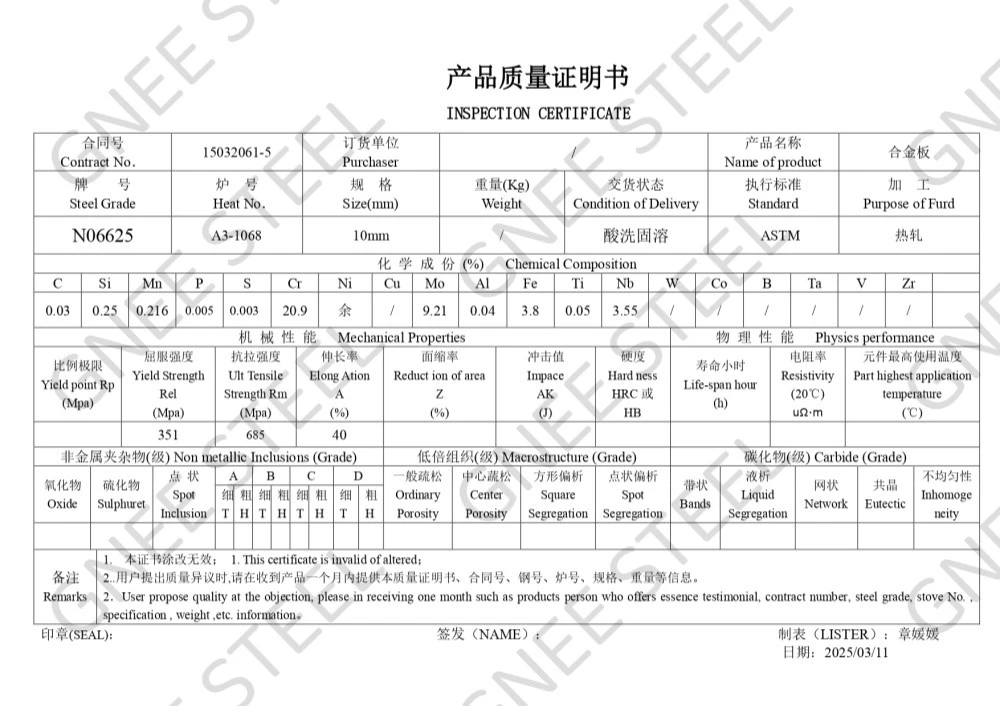
- Material Certification: EN 10204 3.1 / 3.2 certificates with third-party inspection by SGS, BV, or TÜV available on request. NACE MR0175 compliance certificates for Inconel 625 sour-service applications.
- Custom Processing: Cutting to length, beveling, bending, flaring, electropolishing, and U-bending for heat exchanger bundles.
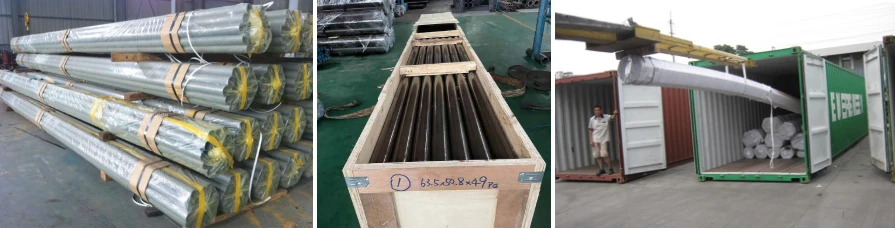
- Export Packaging: Seaworthy wooden cases with plastic end caps, rust-inhibitor VCI paper, and desiccant; FCL or LCL shipment by sea, air, or rail per customer preference.
- 24-Hour Technical Support: Our metallurgical engineers provide material selection guidance, welding procedure specifications (WPS), and corrosion-data consultation within 24 hours of inquiry.

Packaging and Shipping
FAQ
Q: Is Inconel 625 better than 2205?
A: It depends on the application. Inconel 625 is superior in corrosion resistance (PREN 47.5 vs 35), sour-gas qualification (NACE MR0175 to 232°C), and service temperature range (-196 to 650°C vs -50 to 300°C). 2205 is superior in yield strength (450 vs 310 MPa), weight (7.80 vs 8.44 g/cm³), and cost (60–70% cheaper). Choose 625 for aggressive environments and extreme temperatures; choose 2205 for moderate service where budget is a priority.
Q: Can 2205 replace Inconel 625 in seawater applications?
A: Only at ambient seawater temperatures below 40°C. 2205's critical pitting temperature (CPT) in seawater is approximately 40°C, while Inconel 625's CPT exceeds 90°C. In warm seawater (>40°C), subsea service, or where crevice corrosion is a risk, Inconel 625 is the correct choice.
Q: What is the maximum temperature for 2205 duplex?
A: 2205 is limited to 300°C for continuous structural service. Above 300°C, the ferrite phase undergoes 475°C embrittlement (alpha-prime precipitation), causing severe loss of toughness. Above 600°C, sigma-phase formation further degrades properties. Inconel 625 has no such limitation and can operate continuously at 650°C.
Q: Is Inconel 625 qualified for sour gas (H&sub2;S) service?
A: Yes. Inconel 625 (UNS N06625) is listed in NACE MR0175 / ISO 15156 as qualified material for sour oil & gas service up to 232°C, covering environments containing H&sub2;S, CO&sub2;, and chloride brines. 2205 is only marginally qualified for sour service at ambient temperature and is not recommended for elevated-temperature sour gas applications.
Q: Which alloy is stronger, Inconel 625 or 2205?
A: In the annealed condition, 2205 has a higher yield strength (450 MPa vs 310 MPa) due to its duplex microstructure. However, Inconel 625 can be cold-worked (ASTM B444 Grade 1) to achieve tensile strengths exceeding 827 MPa and yield strengths above 415 MPa - surpassing 2205's annealed strength. For high-temperature strength (above 300°C), Inconel 625 is the only viable choice, as 2205 cannot operate at those temperatures.
Q: Can Inconel 625 and 2205 be welded together?
A: Yes. Use ERNiCrMo-3 (AWS A5.14) filler metal for dissimilar welds between Inconel 625 and 2205. No preheat is required. Interpass temperature must be kept below 150°C. The nickel-based filler prevents dilution cracking. Post-weld inspection should verify the ferrite number (FN) on the 2205 side to ensure phase balance is maintained.
Q: What is the price difference between Inconel 625 and 2205?
A: 2205 is typically 60–70% cheaper than Inconel 625 per kilogram, primarily due to the massive difference in nickel content (5.5% vs 58%). However, the life-cycle cost should be evaluated: in aggressive environments, 2205 may require replacement within 10–15 years, while Inconel 625 can last 20–30+ years without failure. Contact GNEE Alloy for current factory-direct pricing on both alloys.



