


Incoloy 800 features fine, recrystallized grain structure, typically ASTM No. 7–9, delivering high ductility and fatigue resistance for moderate-temperature service. Incoloy 800H is controlled to coarse grain ASTM No. 5 or coarser, achieved by higher solution annealing, improving creep rupture strength above 600 ℃. Incoloy 800HT maintains the same coarse grain range as 800H, with tighter grain control plus adjusted aluminum‑titanium content to further stabilize grain boundaries and elevate long‑term creep performance at elevated temperatures.
Incoloy 800 vs 800H vs 800HT:What are the differences in grain size?
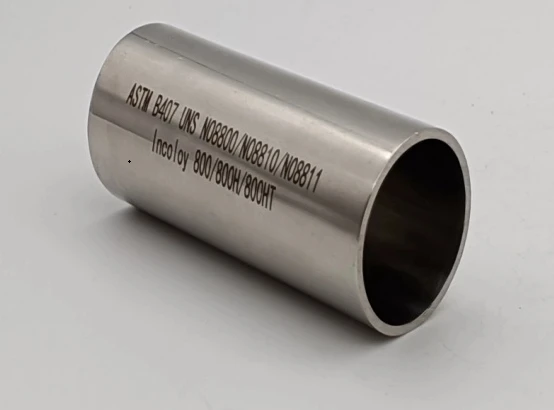
What is Incoloy 800 Alloy?
Incoloy 800 (UNS N08800) is an austenitic nickel-iron-chromium alloy, containing 30–35% nickel and 19–23% chromium. It offers reliable high-temperature strength, good resistance to oxidation, carburization and chloride stress corrosion cracking. This grade has no mandatory grain size requirement and is normally supplied in fine-grained annealed condition. It suits moderate high-temperature service below 593°C, such as heat exchangers, furnace hardware and heating element sheaths. It features stable microstructure and excellent cold formability for general corrosive and thermal environments.
What is Incoloy 800H Alloy?
Incoloy 800H (UNS N08810) is a modified version of Incoloy 800 optimized for creep and stress rupture performance. It controls carbon within 0.05–0.10% and requires high-temperature solution annealing to achieve ASTM grain size 5 or coarser. The coarse grain structure reduces grain boundary sliding under long-term thermal load. It is widely used for high-temperature pressure components above 600°C, including reformer headers, furnace tubes and steam superheater parts in petrochemical and power plants. It is ASME code-approved for high-temperature pressure vessel service.
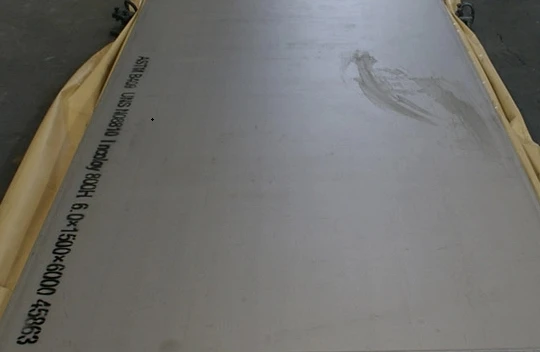
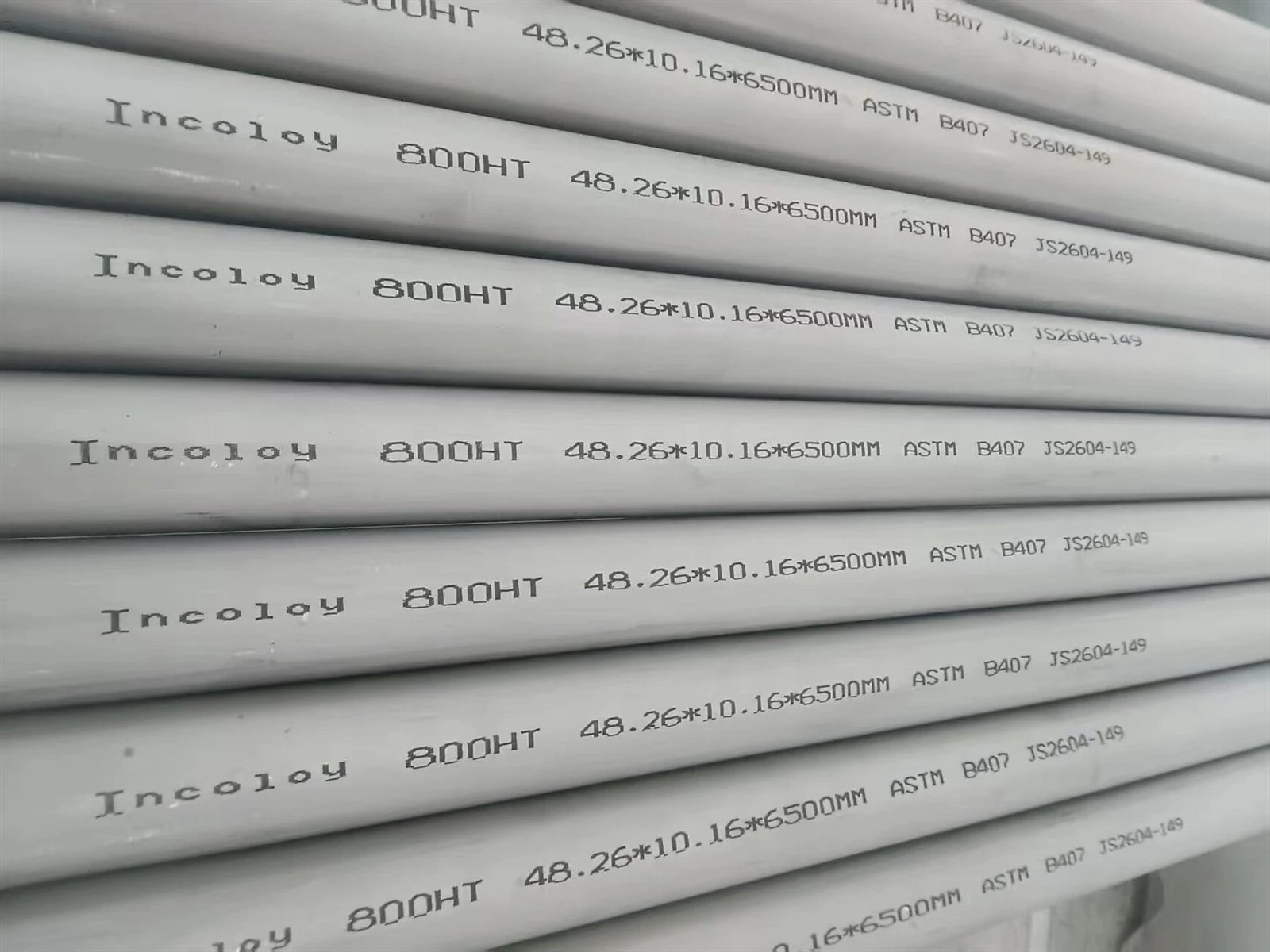
What is Incoloy 800HT Alloy?
Incoloy 800HT (UNS N08811) is the highest-performance variant of the 800 series, built on 800H with strictly controlled Al+Ti content at 0.85–1.20%. It also requires ASTM grain size 5 or coarser after high-temperature solution annealing. Precipitation of gamma prime phase delivers extra high-temperature strengthening, giving better creep rupture strength than 800H. It is designed for sustained heavy load at 760–980°C, commonly adopted for ethylene cracking coils, steam methane reformer tubes and critical furnace components demanding long design life.
Incoloy 800 vs 800H vs 800HT: Grain Size Comparison Table
Grain size is a core metallurgical index for creep performance. Incoloy 800 has no grain size rule and is fine-grained. Both 800H and 800HT require ASTM 5 or coarser grains from high-temperature solution treatment. 800HT adopts a preferred 2.5–5 range to deliver better long-term creep rupture strength than 800H.
| Alloy Grade | UNS No. | ASTM Mandatory Grain Size | Typical Supplied Grain Size | Notes |
|---|---|---|---|---|
| Incoloy 800 | N08800 | No mandatory grain size requirement | ASTM 7 ~ 8 (fine grain) | Standard does not restrict grain size; conventional low-temp annealed fine grain |
| Incoloy 800H | N08810 | ASTM 5 or coarser | ASTM 3 ~ 5 | Must meet ASTM 5 minimum, achieved by high-temperature solution annealing |
| Incoloy 800HT | N08811 | ASTM 5 or coarser | Recommended ASTM 2.5 ~ 5 | Same baseline requirement as 800H; tighter grain range for optimized creep performance |
Note:The higher the ASTM grain size number, the finer the grains; the lower the number, the coarser the grains. Coarser grains reduce grain boundary sliding and improve high-temperature creep rupture life, but they reduce room-temperature toughness. A common procurement misconception is that coarse grains do not automatically equal Alloy 800H/800HT-carbon content and solution annealing temperature must also meet the required standards simultaneously.
Service Temperature Limits & Key Notes for Incoloy 800, 800H and 800HT
Incoloy 800 (UNS N08800)
- Below 593°C:Preferred operating range. It delivers good oxidation resistance, excellent formability and stress corrosion resistance. No creep-based design risk for short-term or cyclic load.
- Above 593°C:Not recommended for long-duration sustained load. Its fine grain structure and uncontrolled carbon content lead to fast grain boundary sliding and poor creep rupture strength. It may suffer premature deformation under constant high-temperature stress.
- Extra reminder:It can be used for intermittent high-temperature service, but do not adopt it for pressure components designed by creep rules.
Incoloy 800H (UNS N08810)
- 600°C ~ 850°C:Its optimum service window. Coarse grain and controlled carbon stabilize creep performance for long-term static load, widely used for reformer tubes and superheater headers.
- Below 600°C:Mechanically usable, but its coarse grain brings slightly lower room-temperature toughness than standard 800. It is over-engineered and not economical for low-temperature corrosion-only conditions.
- Above 850°C:Oxidation rate accelerates sharply. Its creep advantage gradually weakens, and scaling and carburization risk rise obviously. Select 800HT instead for continuous service above 850°C.
Incoloy 800HT (UNS N08811)
- 700°C ~ 980°C:Design temperature range. Controlled Al+Ti forms gamma prime precipitates, providing superior creep rupture strength at ultra-high temperature. It is the first choice for ethylene cracking coils and methane reformers.
- Below 700°C:Creep strengthening effect from γ' phase is not fully activated. High alloy cost cannot bring extra benefit, so 800H is more cost-effective.
- Above 980°C:Gamma prime phase will dissolve, alloy strength drops rapidly. Severe oxidation and metal dusting may occur, and protective coating is usually required.
Incoloy 800 vs 800H vs 800HT: Comparison of Chemical Properties
While the base elements remain consistent across the Incoloy 800 series alloys, subtle adjustments in carbon, aluminum, and titanium content create significant differences in performance. The table below summarizes the key compositional distinctions:
| Alloy | Carbon Content (%) | Aluminum Content (%) | Titanium Content (%) | Nickel (%) | Chromium (%) | Iron (%) |
|---|---|---|---|---|---|---|
| Incoloy 800 | Up to 0.10 | 0.15 – 0.60 | 0.15 – 0.60 | 30.0–35.0 | 19.0–23.0 | ≥ 39.5 |
| Incoloy 800H | 0.05 – 0.10 | 0.15 – 0.60 | 0.15 – 0.60 | 30.0–35.0 | 19.0–23.0 | ≥ 39.5 |
| Incoloy 800HT | 0.06 – 0.10 | 0.25 – 0.60 | 0.25 – 0.60 | 30.0–35.0 | 19.0–23.0 | ≥ 39.5 |
The most notable difference lies in the carbon content. Incoloy 800H and 800HT both require a minimum carbon level, which promotes carbide formation. This adjustment strengthens the alloy and improves creep resistance, especially at temperatures above 600°C. Incoloy 800HT further increases the minimum aluminum and titanium content. These elements form stable intermetallic compounds, such as Ni₃(Al,Ti), which enhance oxidation resistance and mechanical strength during prolonged high-temperature exposure.
- Incoloy 800: Suitable for general high-temperature service below 650°C.
- Incoloy 800H: Designed for improved creep resistance above 650°C due to higher carbon.
- Incoloy 800HT: Offers the best performance at temperatures up to 925°C, thanks to strict control of carbon, aluminum, and titanium.
Note: The nominal composition of Incoloy 800HT features about 19% chromium, 70% iron, and 11% nickel, with tightly controlled carbon, aluminum, and titanium content. This composition ensures a single-phase matrix and excellent stability during long-term service.
Incoloy 800 vs 800H vs 800HT: Comparison of Mechanical Properties
The Incoloy 800 series alloys deliver reliable strength across a wide temperature range. Engineers often select these alloys for their ability to maintain mechanical stability during both room temperature and high-temperature service. The following table summarizes key performance metrics from laboratory tests:
| Performance Metric | Test Type | Temperature (°C) | Value / Observation |
|---|---|---|---|
| Tensile Strength (As-Welded) | Rotary friction weld | Room temp | 546 ± 6 MPa |
| Yield Strength (As-Welded) | Rotary friction weld | Room temp | 265 ± 4 MPa |
| Elongation (As-Welded) | Rotary friction weld | Room temp | 25 ± 2 % |
| Tensile Strength (Post-Weld Heat Treated) | Rotary friction weld | Room temp | 576 ± 5 MPa |
| Yield Strength (Post-Weld Heat Treated) | Rotary friction weld | Room temp | 297 ± 5 MPa |
| Elongation (Post-Weld Heat Treated) | Rotary friction weld | Room temp | 27 ± 3 % |
Incoloy 800 vs 800H vs 800HT:Creep Resistance Comparison
Creep strength rises sequentially from 800 to 800H then 800HT. Fine grain of standard Incoloy 800 brings poor long-term creep resistance. 800H gains improvement via carbon control and coarse grain, while 800HT achieves the best rupture strength with strictly regulated Al+Ti precipitation.
| Grade | UNS | Relative creep rupture performance | Typical service temperature | Core metallurgical reason |
|---|---|---|---|---|
| Incoloy 800 | N08800 | Lowest | ≤593°C | No strict C / Al+Ti control, fine grain, not designed for long creep loading |
| Incoloy 800H | N08810 | Medium | 600–850°C | Controlled carbon + coarse grain (ASTM5+), suppress grain boundary sliding |
| Incoloy 800HT | N08811 | Highest | 700–980°C | Controlled C + tight Al+Ti (0.85–1.20%) + coarse grain, gamma prime strengthening |
Incoloy 800 vs 800H vs 800HT:Heat Treatment Process Comparison
Heat treatment is the key to lock grain size and creep performance. 800 uses conventional low-temperature annealing. 800H and 800HT demand high-temperature solution annealing to grow coarse grains. Improper lower-temperature annealing will downgrade their creep properties permanently.
| Grade | UNS | Required solution annealing | Target grain size | Cooling method | Allowable alternative annealing |
|---|---|---|---|---|---|
| Incoloy 800 | N08800 | 980–1100°C anneal (not mandatory high temp) | No requirement, ASTM7–8 fine grain | Air cool / rapid cool | Low-temperature stress relief acceptable |
| Incoloy 800H | N08810 | Min 1121°C (2050°F) solution anneal | ASTM 5 or coarser | Rapid cooling | Low-temperature annealing forbidden for creep-critical parts |
| Incoloy 800HT | N08811 | 1143–1177°C (2090–2150°F) solution anneal | ASTM 5 or coarser, preferred ASTM2.5–5 | Rapid cooling | Low-temperature annealing forbidden for creep-critical parts |
Applications of Incoloy 800 vs 800H vs 800HT
Incoloy 800 (UNS N08800)
- Medium-temperature heat exchangers where creep is not the main design factor
- Furnace fixtures, heating element sheaths and oven components below 593°C
- Piping and tanks for corrosive process fluids with chloride stress corrosion risk
- Cold-formed parts requiring excellent ductility and bendability
- General petrochemical equipment with intermittent high-temperature exposure
Incoloy 800H (UNS N08810)
- Steam superheater tubes and headers for power boilers
- Primary reformer tubes, manifolds and furnace radiant tubes for petrochemical plants
- High-temperature pressure vessels operating steadily at 600–850°C
- Waste heat recovery equipment with long-term sustained thermal load
- ASME-code pressure parts designed based on creep rupture properties
Incoloy 800HT (UNS N08811)
- Ethylene cracking coils and steam methane reformer tubes at 700–980°C
- Critical high-temperature furnace components demanding top creep rupture strength
- Hydrogen production equipment under continuous high heat and carburizing atmosphere
- Thermal processing units with strict long design life requirements
- High-temperature piping for advanced energy and thermal cracking systems
GNEE Nickel-Based Alloy Supplier
Hastelloy Series: Hastelloy C-276, Hastelloy C-22, Hastelloy B-3, Hastelloy C-4. Mainstream materials for highly corrosive operating conditions, widely used in chemical reactors and flue gas desulfurization (FGD) units.
Inconel Nickel-Based Superalloys: Inconel 718, Inconel 625, Inconel 600, Inconel 690. Stable high-temperature strength, suitable for aerospace structural components, gas turbines, and nuclear power heat exchange equipment.
Incoloy Iron-Nickel-Based Corrosion-Resistant Alloys: Incoloy 800H, Incoloy 800HT, Incoloy 825, Incoloy 926. Combining high-temperature oxidation resistance with resistance to acid and alkali media corrosion.
Cast Nickel-Based Superalloys: Inconel 713C, Inconel 713LC. Excellent high-temperature creep and oxidation resistance, commonly used in gas turbines and turbocharger turbine castings.
Monel Alloys: Monel 400, Monel K-500. Resistant to seawater corrosion, making them common materials for marine equipment, valves, and pipe fittings.
Super Austenitic Stainless Steels: 254SMO, 904L, 654SMO. Outstanding resistance to pitting and crevice corrosion, suitable for seawater desalination and chloride-containing highly corrosive chemical environments.
Duplex Stainless Steels: 2205, 2507, S32760. High strength with excellent resistance to chloride stress corrosion cracking.
Precipitation-Hardening Stainless Steels: 17-4PH, 15-5PH, 17-7PH. High strength levels, used for precision structural components, pumps, valves, and fasteners.

FAQ:
Q: Can GNEE ALLOY provide original mill material certificates?
A: All imported steels can be supplied with original mill test certificates from overseas steel mills, complete with supporting inspection reports such as spectrometry and non-destructive testing (NDT), ensuring full batch traceability.
Q: What product forms are available for supply?
A: Round bars, plates, seamless pipes, forgings, flanges, etc. We also provide supporting processing services such as cutting and heat treatment.
Q: What is the typical delivery lead time?
A: Standard stock specifications can be dispatched rapidly; overseas futures orders rely on long-term agency partnerships to lock in production scheduling and arrival timelines.
Q:What is the main difference between Incoloy 800, 800H, and 800HT?
A:The main difference lies in the control of carbon, aluminum, and titanium content. Incoloy 800HT has the strictest limits, which improves creep resistance and high-temperature strength.
Q:Which industries most often use Incoloy 800 series alloys?
A:Power generation, chemical processing, oil and gas, and nuclear industries use these alloys. They choose them for heat exchangers, reformer tubes, and furnace parts exposed to high temperatures and corrosive environments.
Q:How does heat treatment affect Incoloy 800 series alloys?
A:Heat treatment changes grain size and mechanical properties. Proper annealing increases strength and creep resistance. Incoloy 800HT benefits most from precise heat treatment, which ensures long-term stability at high temperatures.



