

1. Difference in Production Process
Soft pure copper, usually marked as M (Annealed), is produced by cold working such as rolling, drawing or extrusion, followed by high-temperature annealing at approximately 400–550°C and slow cooling. This heating process eliminates internal stress caused by plastic deformation, allowing distorted grains to recrystallize and restore the original soft properties of copper.
Hard pure copper, marked as Y (Hard), is directly formed through cold working such as drawing, rolling or stamping without subsequent annealing. Severe plastic deformation during cold working leads to significant work hardening, which greatly increases strength and hardness but reduces plasticity.
2. Difference in Microstructure
Microstructurally, soft pure copper consists of uniform, equiaxed and fully recrystallized grains. After annealing, internal stress is relieved, dislocations are greatly reduced, and grain boundaries are regular. This structure gives copper excellent ductility and toughness.
In contrast, hard pure copper retains a fibrous and elongated grain structure caused by cold deformation. Grains are compressed, stretched and fragmented, with a sharp increase in dislocation density and tangled dislocations inside the material. This microstructure is the fundamental reason for high strength and high hardness.
3. Difference in Mechanical Properties and Physical Properties
Soft pure copper has low strength and hardness but extremely high ductility. Its tensile strength is generally around 200–240 MPa, and elongation can reach more than 35%. It is very soft, with excellent electrical and thermal conductivity close to the theoretical optimal value of pure copper. It hardly rebounds when bent and can be formed multiple times without cracking.
Hard pure copper has significantly higher strength and hardness due to work hardening. Its tensile strength can reach 300–350 MPa, and hardness is nearly twice that of soft copper. However, plasticity is greatly reduced, with elongation generally below 4–10%. It has strong rigidity and obvious springback during bending. Excessive bending may cause cracks or fractures. In terms of conductivity, hard pure copper is slightly lower than soft copper, but the difference is relatively small in general industrial applications.
4. Difference in Formability and Processing Performance
Soft pure copper is extremely easy to form. It can be bent, flared, deep-drawn, twisted and punched without damage. It is suitable for complex structural parts requiring multiple deformations. When processed, it is not easy to break and has stable dimensional performance.
Hard pure copper has poor formability. It is difficult to bend, has high resistance during deformation, and is prone to fracture under large deformation. It is only suitable for products with simple shapes and little deformation, or components that require high dimensional stability and rigidity.
5. Difference in Typical Applications
Soft pure copper is widely used in scenarios requiring high plasticity, high conductivity and easy forming. Typical applications include various cables, wires, motor windings, transformer conductors, refrigeration coils, water pipes, heat exchangers, and deep-drawn electronic components.
Hard pure copper is used in situations requiring high strength, high rigidity and stable shape. Common applications include busbars, rigid conductors, motor commutators, structural parts, high-strength wires, straight pipes and parts that need to maintain shape without deformation.


6. Simple On-Site Identification Methods
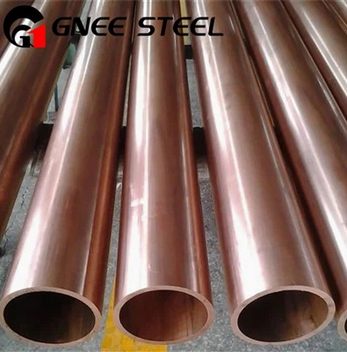
In actual production and application, soft and hard pure copper can be distinguished simply without professional equipment. Bending test is the most intuitive method: soft copper can be easily bent by hand, can reach large angles and even be folded without cracking; hard copper is difficult to bend, has obvious rebound, and may crack if bent excessively. In addition, the surface hardness can be felt by hand or slight scratching: soft copper is relatively soft, while hard copper has a hard surface and strong resistance to scratching. Material markings can also be used for judgment: M represents soft state, Y represents hard state, and Y2 represents half-hard state.
In summary, soft pure copper focuses on plasticity and formability, while hard pure copper focuses on strength and rigidity. Users can select the appropriate state according to processing requirements and service conditions.


