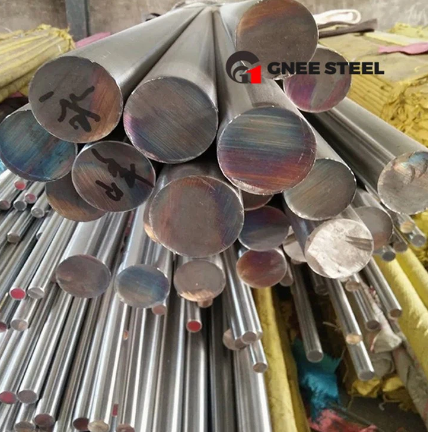
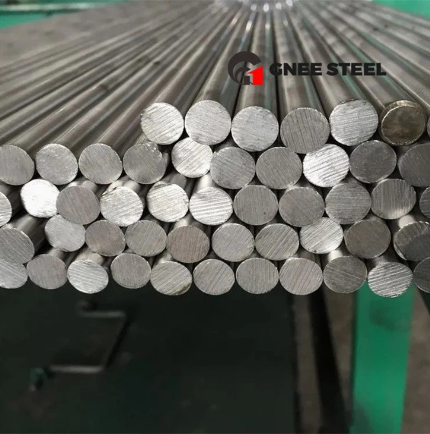
1: What is Hastelloy C-4 (UNS N06455), and what key property differentiates its round bar form from other nickel-chromium-molybdenum alloys?
Hastelloy C-4 (UNS N06455) is a nickel-chromium-molybdenum alloy specifically engineered for exceptional thermal stability and resistance to intergranular attack after exposure to high temperatures. Its nominal composition is approximately 65% Ni, 16% Cr, 16% Mo, with very low levels of carbon, silicon, and iron, and it is stabilized with titanium. This deliberate chemistry was developed as a successor to alloys like C-276 to solve a specific problem: sensitization and embrittlement caused by prolonged exposure in the 550-1100°C (1020-2010°F) range.
The key differentiating property of C-4 round bars is their metallurgical stability under thermal stress. While alloys like C-276 offer superb as-welded corrosion resistance, they can form detrimental mu (μ) and P-phase intermetallics in the heat-affected zone (HAZ) after prolonged high-temperature exposure. In contrast, the C-4 formulation (low Fe, Si, and Ti stabilization) dramatically retards the precipitation of these harmful phases. This makes C-4 round bars the superior choice for components that are fabricated (welded or heavily machined) and then placed into high-temperature service, such as furnace hardware, heat exchanger internals, and flare tips, where long-term structural integrity at temperature is paramount.
2: In what high-temperature, corrosive applications are Hastelloy C-4 Round Bars specifically preferred over other C-type alloys?
Hastelloy C-4 round bars are specified for applications where components must withstand simultaneous high-temperature exposure and corrosive atmospheres over extended periods, particularly where thermal cycling is involved. Their use is less about the peak corrosion resistance of the C-family and more about maintaining that resistance after thermal aging.
Primary Application Areas:
Pollution Control & Flare Systems: This is a classic application. Flare tip components (pilot arms, tip brackets, ignition nozzles) machined from C-4 round bars are exposed to the extreme heat of combustion, cyclic thermal shock from ignition/shutdown, and corrosive combustion by-products (sulfur compounds, chlorides). C-4 resists oxidation and, critically, does not embrittle, ensuring mechanical reliability.
Chemical Process Furnace Internals: For tubesheets, hanger rods, support pins, and radiant tube brackets in ethylene cracking or reformer furnaces, C-4 bars provide long-term stability against carburization and chloride attack at temperatures up to 1100°C, without suffering the embrittlement that can cause premature failure in other alloys.
Waste Incineration & Thermal Oxidizer Hardware: Components like agitator shafts, grate bars, and linkage arms are subject to oxidizing/sulfidizing atmospheres and thermal cycling. C-4's stability prevents loss of toughness.
Pharmaceutical & Fine Chemical Processing: For reactor agitator shafts and thermowell stems in processes involving high-temperature, chloride-containing organic reactions (e.g., certain chlorinations), where post-fabrication heat treatment of the assembly is not feasible, C-4 offers reliable as-welded stability.
In these scenarios, while C-276 might offer marginally better initial corrosion resistance in some tests, C-4 is chosen for its predictable, long-term performance and retention of ductility after thousands of hours of thermal exposure.
3: What are the critical heat treatment and fabrication guidelines unique to Hastelloy C-4 Round Bars?
Fabrication of C-4 components requires protocols that leverage its stability while avoiding the conditions it was designed to resist.
Heat Treatment:
Solution Annealing: C-4 round bars are supplied in the solution-annealed condition (heated to ~1120-1170°C / 2050-2140°F and rapidly cooled). This produces a homogeneous, single-phase austenitic structure with optimal corrosion resistance and ductility.
Post-Fabrication Heat Treatment: The major advantage of C-4 is that post-weld heat treatment is often unnecessary to achieve corrosion resistance, unlike many other nickel alloys. However, for the highest level of assurance in severely corrosive service, a full solution anneal after welding or heavy cold work is still recommended. The key is that if heat treatment is performed, C-4 is much less likely to suffer from harmful precipitation during the heating and cooling cycle itself.
Stress Relieving: Intentional stress relieving in the intermediate temperature range (550-900°C) should be avoided, as it can still precipitate carbides, albeit much slower than in other alloys.
Fabrication Guidelines:
Welding: C-4 exhibits excellent weldability with matching filler metal (ERNiCrMo-7). Standard GTAW (TIG) procedures with argon shielding and backing gas are used. Its low thermal expansion coefficient minimizes distortion. The primary benefit is that the weld and HAZ remain ductile and corrosion-resistant even without post-weld heat treatment, a significant fabrication advantage.
Machining: Similar to other Ni-Cr-Mo alloys, C-4 work-hardens rapidly. It requires sharp, positive-rake carbide tooling, moderate speeds, high feed rates, and heavy depths of cut to shear beneath the work-hardened layer. Copious coolant is essential.
Cold Working: While ductile in the annealed state, significant cold forming should be followed by a solution anneal to restore optimal properties, especially if the part will see corrosive service.
4: How does the performance and cost of Hastelloy C-4 Round Bars compare to the more common Hastelloy C-276?
The choice between C-4 and C-276 round bars involves a clear technical trade-off driven by the service environment.
| Aspect | Hastelloy C-4 (UNS N06455) | Hastelloy C-276 (UNS N10276) |
|---|---|---|
| Key Strength | Superior thermal stability. Exceptional resistance to embrittlement from prolonged exposure in the 550-1100°C range. | Superior, broad-spectrum corrosion resistance in both oxidizing and reducing media, especially in as-welded condition. |
| Primary Application Driver | Long-term service at high temperature where microstructural stability is critical (e.g., flare tips, furnace parts). | Service in the most severe wet corrosive environments across a wide temperature range (e.g., HCl/Cl₂, FGD scrubbers). |
| Weldability & PWHT | Excellent. Generally does not require post-weld heat treatment to resist intergranular attack in the HAZ. | Excellent, but the HAZ can be susceptible to precipitation. For severe service, PWHT is often recommended to restore optimal corrosion resistance. |
| Cost | Typically slightly lower than C-276, due to the absence of tungsten and slightly lower molybdenum content. | Higher, reflecting its more comprehensive alloying (with W) and slightly more complex metallurgy. |
| Typical Bar Application | High-temperature structural components: shafts, fasteners, hangers in hot gas/combustion environments. | Critical components in wet process equipment: pump shafts, valve stems, mixer shafts in aggressive chemical liquors. |
Conclusion: Choose C-4 round bars when the application involves sustained high temperatures and thermal cycling where embrittlement is the primary failure mode. Choose C-276 round bars when facing the most aggressive mixed acids, oxidizing chlorides, or where the highest possible as-fabricated corrosion resistance in a "wet" process is required. C-4 is a specialist for thermal stability; C-276 is the broader-corrosion specialist.
5: What quality control and certification tests are essential for C-4 Round Bars, particularly to verify their thermal stability specification?
Ensuring that C-4 round bars meet their specification for thermal stability requires tests beyond standard chemical and mechanical checks.
1. Standard Mandatory Tests:
Chemical Analysis (Ladle & Product): Verification of key compositional limits, especially low carbon (<0.015%), low iron (<3.0%), low silicon (<0.08%), and the presence of stabilizing titanium. This chemistry is the foundation of its stability.
Mechanical Testing: Tensile, yield, elongation, and hardness at room temperature to confirm annealed condition.
Corrosion Test: While not always required for bar stock, a ASTM G28 Method A (Ferric Sulfate-Sulfuric Acid Test) may be specified to confirm resistance to intergranular attack in the as-supplied condition.
2. Specialized Tests for Thermal Stability Verification:
Aging Test & Subsequent Evaluation: This is the critical proof of performance. A sample from the heat/lot may be subjected to a simulated aging treatment, such as holding at 760°C (1400°F) for 16 hours (per some specifications) and then air cooling.
Post-Aging Ductility Test: The aged sample is subjected to a bend test or impact test. A significant drop in ductility or impact energy would indicate harmful phase precipitation. C-4 should pass this test easily.
Post-Aging Corrosion Test: The aged sample is then subjected to the ASTM G28 Method A test. A high corrosion rate would indicate sensitization due to precipitation. C-4 is designed to show minimal increase in corrosion rate after such aging.
3. Certification & Documentation:
Certified Mill Test Report (CMTR): Must include full traceability (heat number), all chemical/mechanical results, and a statement of compliance with ASTM B574 for Rod/Bar (which covers N06455).
Additional Certification: For critical applications, the mill may be required to provide test reports from simulated aging studies performed on representative material from the master heat, proving the stability of the product form.
Micrographic Examination: A metallographic sample, often after the aging test, may be examined to ensure the absence of continuous grain boundary precipitates.
This stringent QA focus ensures that the C-4 round bar will perform as designed-not just initially, but after years of exposure to the high-temperature conditions it was engineered to withstand.