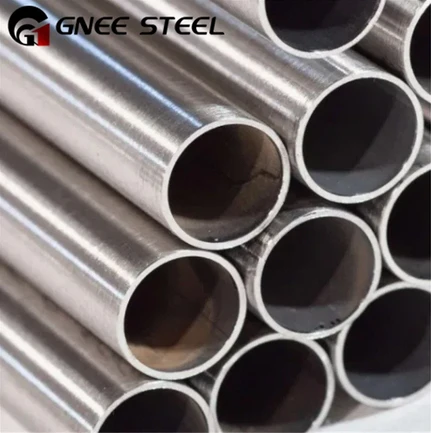
1. What are the fundamental advantages of choosing welded pipe over seamless pipe for these nickel alloys, and what are the potential trade-offs?
The choice between welded and seamless pipe is a fundamental economic and technical decision. For the listed alloys, welded pipe offers significant advantages in cost and availability for certain applications, but with critical considerations.
Advantages of Welded Pipe:
Cost-Effectiveness: This is the primary driver. Welded pipe is generally 20-50% less expensive than seamless pipe of the same size and alloy. The manufacturing process (forming and welding coil or plate) is more efficient and has a higher yield than the complex extrusion and piercing process used for seamless pipe.
Availability in Large Sizes: Welded pipe is the only practical option for large diameters (e.g., over 24 inches) and heavy wall thicknesses. Producing seamless pipe in these dimensions is technically challenging and prohibitively expensive.
Superior Surface Finish (ID/OD): The starting material (coil or plate) often has a better and more consistent surface finish than the billet used for seamless pipe. This can be beneficial for corrosion resistance and fluid flow.
Tighter Wall Thickness Tolerances: The raw material is rolled to a consistent thickness, resulting in more uniform wall thickness around the pipe's circumference compared to seamless pipe.
Potential Trade-offs and Mitigations:
Weld Integrity: The weld seam is a potential point of failure. It must be meticulously produced and 100% inspected to ensure it is free of defects like lack of fusion, porosity, or cracks.
Anisotropic Properties: The mechanical properties and corrosion resistance in the weld and Heat-Affected Zone (HAZ) can differ from the base metal. Proper filler metal selection and welding procedures are critical to minimize this.
Perception and Specification: Despite modern advancements, some legacy specifications and engineers in critical service (e.g., ASME BPVC Section I) may mandate seamless pipe due to historical precedent.
Conclusion: Welded pipe is an excellent, cost-effective choice for low to medium-pressure applications, large diameters, and where the full-length weld is verified through Non-Destructive Testing (NDT) like radiography or ultrasonics. It is widely used for process piping, transfer lines, and structural components where the cost savings outweigh the perceived risk.
2. How does the welding process for a corrosion-resistant alloy like Incoloy 825 differ from that of a high-temperature strength alloy like Incoloy 800HT?
The welding procedure is tailored to preserve the primary property for which the alloy was selected. The goal for 825 is to maintain corrosion resistance, while for 800HT, it is to preserve high-temperature strength and stability.
Welding Incoloy 825 (Corrosion Resistance Focus):
Key Challenge: Preventing "weld decay" or sensitization. This occurs when chromium carbides precipitate in the HAZ, depleting the local chromium content and making it susceptible to corrosion.
Alloy Design: 825 is "stabilized" with Titanium, which preferentially combines with carbon, preventing chromium depletion.
Welding Practice:
Filler Metal: Use a matching stabilized filler like ERNiFeCr-1 (Inconel 625 filler is also common for its superior pitting resistance).
Low Heat Input: Employ stringer beads and control interpass temperature (max ~150°C/300°F) to minimize time in the sensitization temperature range.
Back Purging: Essential to use inert gas (Argon) on the root side to prevent oxidation and formation of a low-chromium, contaminated root bead.
Welding Incoloy 800HT (High-Temperature Strength Focus):
Key Challenge: Preserving creep strength and ductility in the weld zone. The Al and Ti content in 800HT is critical for forming strengthening precipitates.
Alloy Design: 800HT has carefully controlled levels of Al, Ti, and Carbon for optimal high-temperature performance.
Welding Practice:
Filler Metal: Use a filler metal designed for high-temperature service, typically ERNiFeCr-1 or ERNiCr-3 (Inconel 82). The weld must have similar strength and ductility at temperature.
Heat Input Control: While still controlled, the focus is on achieving full penetration and a sound weld profile to avoid stress concentrators that can initiate creep cracks.
Post-Weld Heat Treatment (PWHT): PWHT is often required for 800HT welded assemblies to relieve residual stresses that can accelerate creep failure and to ensure a stable microstructure for high-temperature service.
3. What is the specific purpose of Monel R405, and why is it uniquely suited for automatic machining into pipe fittings?
Monel R405 (UNS N04405) is a free-machining variant of Monel 400. Its composition is nearly identical, with one critical addition: a controlled amount of Sulfur (~0.025-0.060%).
Purpose and Mechanism:
The added sulfur forms inclusions of manganese sulfide within the metallurgical structure. These inclusions act as built-in chip breakers during machining. This results in:
Short, Brittle Chips: Instead of long, stringy, tough chips typical of standard Monel 400, R405 produces small, broken chips that are easily cleared from the machining area.
Increased Machining Speeds: Allows for significantly higher feed rates and cutting speeds.
Improved Surface Finish: Reduces tool wear and built-up edge, leading to a better finish.
Extended Tool Life: Lessens the cutting forces and heat generated, reducing tool wear.
Application in Welded Pipe Systems:
While not used for the pressure-containing pipe wall itself (where toughness is paramount), Monel R405 is the premier material for manufacturing screwed or socket-weld fittings (elbows, tees, couplings) that are used with Monel 400 welded pipe systems. It allows for the high-volume, economical production of complex threaded components that would be prohibitively expensive and time-consuming to machine from standard Monel 400.
Trade-off: The sulfur addition slightly reduces ductility and corrosion resistance compared to Monel 400, making it unsuitable for the welded pipe body but perfectly acceptable for thick-walled fittings.
4. For high-temperature service, what is the progressive difference between Incoloy 800, 800H, and 800HT, and how does this influence the choice of welded pipe?
The progression from 800 to 800H to 800HT represents a deliberate optimization for elevated temperature service, specifically for creep strength – the material's resistance to slow, continuous deformation under stress at high temperatures.
The Key Difference: Carbon Content and Grain Structure
Incoloy 800 (UNS N08800): This is the base alloy. It has a standard carbon content (0.06% max) and is typically supplied in a solution-annealed condition with a fine grain size. It offers good general corrosion and oxidation resistance but has the lowest creep strength of the three.
Incoloy 800H (UNS N08810): The "H" stands for "High-temperature." It has a controlled higher carbon content (0.05-0.10%). This material is solution-annealed at a higher temperature (typically above 2100°F / 1150°C), which results in a coarser grain size (ASTM 5 or coarser). The coarse grains provide superior creep rupture strength at temperatures above 1100°F (595°C).
Incoloy 800HT (UNS N08811): The "HT" stands for "High-Temperature with Titanium." It has the same carbon range as 800H but with a tighter control of the Al + Ti content (0.85-1.20%). This ratio is optimized to form a more stable and effective dispersion of strengthening precipitates (gamma prime) during long-term exposure at high temperatures, providing the highest creep strength of the three.
Influence on Welded Pipe Choice:
When specifying welded pipe for a high-temperature process (e.g., furnace tubing, reformer pigtails):
For general heat resistance, 800 may suffice.
For sustained loading at high temperatures (e.g., 1200-1500°F / 650-815°C), 800H welded pipe is specified, and the mill must certify the heat treatment and grain size.
For the most demanding creep conditions and longest design life, 800HT is chosen, and the mill must certify both the chemistry (Al+Ti) and the grain size.
The weld procedure for 800H/HT must be qualified to ensure the weld joint possesses adequate high-temperature properties.
5. What critical quality assurance steps are required during the manufacturing of welded pipe for these alloys to ensure performance in corrosive service?
Producing a reliable welded pipe for corrosive service requires a rigorous Quality Assurance (QA) protocol that focuses on the integrity of the weld seam. "Fit-for-service" quality is verified through a series of mandatory checks.
1. Raw Material Verification:
The coil or plate must come with a certified Mill Test Report (MTR) verifying the chemistry and properties conform to the specified alloy (e.g., ASTM B424 for Incoloy 825 plate).
2. Non-Destructive Testing (NDT) of the Weld Seam:
This is the cornerstone of QA for welded pipe.
100% Radiographic Testing (RT): Uses X-rays or gamma rays to create an image of the weld, revealing internal defects like porosity, slag inclusions, and lack of fusion. This is a fundamental requirement for process piping.
Automated Ultrasonic Testing (UT): Uses high-frequency sound waves to detect planar defects (like cracks and lack of fusion) that can be difficult to see with RT. It is highly sensitive and often used in tandem with RT.
Eddy Current Testing (ECT): Often used for smaller diameter tubes to detect surface and near-surface flaws.
3. Post-Weld Heat Treatment (PWHT):
Depending on the alloy and service, a full-body solution anneal may be required. For Incoloy 825, this is done to dissolve any deleterious phases and restore maximum corrosion resistance across the entire pipe, including the HAZ.
4. Final Testing and Certification:
Hydrostatic Test: Every length of pipe is pressurized to a specified level to prove its structural integrity.
Surface Examination: The ID and OD are inspected for defects. For corrosive service, a smooth, polished finish is often specified.
Final Certification: The pipe manufacturer issues an MTR that summarizes all steps, including the NDT results and heat treatment records, providing full traceability.
A purchaser should specify these QA steps (e.g., "ASTM B775, Welded Incoloy 825 Pipe, with 100% RT and PWHT") to ensure they receive a product capable of performing in a demanding corrosive environment.