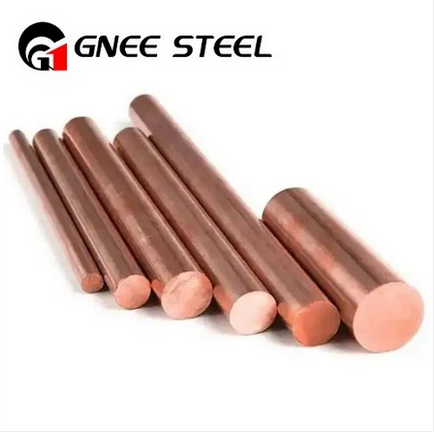
1. C17510 is classified as a high-strength, high-conductivity copper alloy. What is the fundamental precipitation-hardening mechanism that allows it to achieve this unique combination of properties, and what are the two essential heat treatment steps involved?
The fundamental mechanism is precipitation hardening (or age hardening), a process that creates incredibly fine, dispersed particles within the copper matrix to block dislocation movement without severely disrupting electron flow.
The Mechanism:
Solution Treatment: The C17510 bar is heated to a high temperature (around 900-955°C / 1650-1750°F), which dissolves the beryllium and cobalt atoms into a single, homogeneous solid solution.
Quenching: The bar is rapidly cooled (quenched), "freezing" this supersaturated solid solution at room temperature. The alloy is now in a soft, ductile condition ideal for machining or cold working.
Aging (Precipitation Hardening): The bar is then reheated to a lower, precisely controlled temperature (around 450-500°C / 840-930°F) for a specific time. At this temperature, the supersaturated beryllium and cobalt atoms become mobile and precipitate out as extremely fine, coherent particles of a cobalt-beryllide intermetallic phase (e.g., CoBe). These nanoscale particles are the key to its properties:
Strength: They act as potent obstacles to dislocation movement, dramatically increasing strength and hardness.
Conductivity: Because they are coherent and remove the solute atoms from the copper lattice, they restore the lattice regularity, allowing electrons to flow with much less obstruction than in a solid solution.
This two-step heat treatment is what unlocks the alloy's full potential, transforming it from a soft, machinable state into a strong, resilient, and highly conductive engineering material.
2. In the aerospace and defense industries, C17510 bar is often machined into critical components like rocket engine thrust chambers and high-G force connectors. What three specific properties make it indispensable for these extreme applications?
C17510 is selected for these life-or-death applications due to a triad of exceptional properties:
Exceptional Strength-to-Conductivity Ratio: This is its defining characteristic. It can achieve a tensile strength of 690-895 MPa (100-130 ksi) while maintaining a thermal and electrical conductivity of around 45-60% IACS. For context, this is stronger than many steels while retaining the thermal management capability of a decent brass. This allows it to withstand the immense pressures and temperatures in a rocket engine while efficiently conducting heat away to the cooling system, and to maintain signal integrity in a connector under high vibrational loads.
High Fatigue Strength and Excellent Stress Relaxation Resistance: Components in aerospace are subjected to constant vibration and thermal cycling. C17510 has excellent resistance to fatigue failure, meaning it can withstand billions of load cycles. Furthermore, it has outstanding stress relaxation resistance-a critical property for electrical connectors. It maintains its spring force and contact pressure at elevated temperatures (up to ~400°C / 750°F), preventing connectors from loosening and failing over time, which is essential for reliability in high-G force environments.
Good Corrosion and Stress Corrosion Cracking (SCC) Resistance: While not as corrosion-resistant as some copper-nickels, it offers good general corrosion resistance. More importantly, its precipitation-hardened microstructure provides good resistance to stress corrosion cracking, a common failure mode for high-strength alloys in corrosive atmospheres.
3. For a manufacturer machining a complex, high-voltage circuit breaker component from a C17510 bar, the alloy's behavior in the "solution treated" versus "aged" condition is critical. Why is the vast majority of machining performed in the softer, solution-treated condition, and what specific post-machining step is absolutely mandatory?
The machining is performed in the solution-treated (annealed) condition for two primary reasons:
Tool Life and Machinability: In the solution-treated condition, C17510 has a hardness of around Rockwell B 60-75. It is relatively soft, ductile, and gummy, but much more forgiving on cutting tools. Machining in this state results in significantly longer tool life, better surface finishes, and the ability to achieve complex geometries without excessive tool wear or breakage. Attempting to machine the alloy in its fully aged condition (Rockwell C 30-40) would be akin to machining high-strength steel, leading to rapid tool dulling, chipping, and poor surface integrity.
Dimensional Stability: The aging process causes a slight but predictable dimensional change in the part. If a part were mached to final dimensions in the aged state, the preceding heat treatment (solution treating) would cause much larger and less predictable distortions due to stress relief and thermal expansion, making it impossible to hold tight tolerances.
The Absolutely Mandatory Post-Machining Step:
After machining in the solution-treated condition, the component must undergo the final aging heat treatment. This step is non-negotiable. It is this aging process that transforms the soft, precisely machined part into the high-strength, high-conductivity, and resilient final product. The manufacturer must account for the predictable dimensional shifts that occur during aging in their initial machining tolerances.
4. When comparing C17510 to the more common C17200 beryllium copper, what is the key compositional difference that gives C17510 its superior thermal and electrical conductivity, and what is the corresponding trade-off in mechanical performance?
The key difference is the ratio of Beryllium (Be) to Cobalt (Co).
C17200 (High-Strength): Contains ~1.8-2.0% Be and is typically used with a small addition of Co or Ni. This higher beryllium content drives the formation of a higher volume fraction of the hard, strengthening Be-Cu precipitates (GP zones, γ' phase), resulting in very high strength (up to 1380 MPa / 200 ksi) and hardness. However, the high solute content significantly disrupts the copper lattice, leading to lower conductivity (typically 15-22% IACS).
C17510 (High-Conductivity): Contains a lower ~0.4-0.7% Be and a higher ~2.4-2.7% Co. The cobalt combines with the beryllium to form Co-Be precipitates. This chemistry creates a lower volume fraction of strengthening precipitates, which is the reason for its lower ultimate strength and hardness compared to C17200.
The Trade-off: The trade-off is precisely this balance. By sacrificing some ultimate strength (the trade-off), C17510 achieves a much higher electrical and thermal conductivity (45-60% IACS). The lower beryllium content and the different nature of the precipitates cause less disruption to the electron flow in the copper matrix.
Selection Guideline: Choose C17200 when maximum strength and wear resistance are the absolute priorities. Choose C17510 when a superior balance of good strength and high conductivity is required for electrical or thermal management applications.
5. In the context of worker safety, machining C17510 bar requires specific administrative and engineering controls that are not needed for plain copper. What is the specific health hazard associated with its beryllium content, and what is the primary purpose of using flood coolant during machining operations?
The specific health hazard is the potential for Chronic Beryllium Disease (CBD), a serious and irreversible lung disease caused by an immune response to inhaled beryllium particles or fumes.
The Risk: During dry machining, grinding, or any process that creates dust or fumes, microscopic beryllium-containing particles can become airborne. If inhaled, these particles can trigger CBD in sensitized individuals, leading to scarring of lung tissue, reduced lung function, and can be fatal.
Administrative and Engineering Controls:
Engineering Controls (Primary): The use of flood coolant is the most critical engineering control. Its primary purpose is to suppress the generation of airborne dust by keeping the cutting interface wet, weighing down the particles, and carrying them safely away into a filtration system.
Ventilation: Machining must be performed with local exhaust ventilation (LEV) systems, such as hoods at the point of operation, to capture any potential aerosols or mist.
Administrative Controls: These include worker training on beryllium hazards, strict housekeeping procedures (using HEPA-filtered vacuums, no dry sweeping), mandatory use of appropriate personal protective equipment (PPE) where necessary, and a structured medical surveillance program for exposed workers.
These controls are mandated by regulations (e.g., OSHA in the US) and are absolutely essential for ensuring a safe workplace when processing any beryllium-containing alloy, making the handling of C17510 fundamentally different from that of plain copper or brass.