


The Effect of Oxygen Content on the Properties of Pure Copper
Oxygen is one of the most common and influential impurity elements in pure copper. Even very low concentrations of oxygen can significantly change the physical, mechanical, electrical, thermal, and processing properties of copper. In industrial production, oxygen content is usually strictly controlled according to application scenarios, and its impact is mainly reflected in the following aspects.
First, oxygen has an obvious effect on the electrical conductivity of pure copper.
Copper oxide formed by oxygen and copper is a semiconductor compound with much higher resistivity than copper matrix. When oxygen dissolves in copper in the form of solid solution or precipitates as copper oxide particles at grain boundaries, it will hinder the movement of free electrons, increase electron scattering, and thus reduce electrical conductivity. Generally speaking, with the increase of oxygen content, the conductivity of copper decreases gradually. For high-conductivity copper used in cables, wires, motors and transformers, oxygen content must be strictly limited, usually controlled below 10 ppm, otherwise it will directly affect the transmission efficiency and energy consumption of electrical products.
Second, oxygen content determines the thermal conductivity of pure copper.
Similar to conductivity, the existence of oxygen and copper oxide will interfere with the propagation of heat flow in the crystal. High oxygen content reduces the thermal conductivity of copper, making it less suitable for heat dissipation components such as heat sinks, heat exchangers and electronic packaging materials. In contrast, low-oxygen or oxygen-free copper has extremely high thermal conductivity and can quickly export heat, which is essential for high-performance electronic and electrical equipment.
Third, oxygen has a critical impact on the mechanical properties of pure copper, especially plasticity and toughness.
When oxygen content is low, copper still maintains good ductility and malleability, suitable for stamping, drawing, bending and other cold working. However, when oxygen exceeds a certain range, a large number of copper oxide inclusions and brittle phases are formed at grain boundaries, which significantly reduces the plasticity and impact toughness of copper. Such copper is prone to intergranular fracture during processing, and the surface is prone to cracks and orange peel defects. At the same time, the strength and hardness of copper will increase slightly with the increase of oxygen, but this is at the cost of plasticity, which is not conducive to deep processing.
Fourth, oxygen content directly affects the welding performance and hot workability of pure copper, which is also one of the most concerned problems in industrial processing.
Copper containing high oxygen is very easy to produce hydrogen embrittlement during welding or brazing. Hydrogen in the welding atmosphere or flux reacts with copper oxide at high temperature to produce water vapor. A large number of water vapor bubbles accumulate inside the material, resulting in micro-cracks and pores, which seriously reduce the joint strength and air tightness. Therefore, high-oxygen copper is difficult to weld reliably, and it is also prone to cracking during hot rolling, hot forging and other thermal processing. In contrast, oxygen-free copper or low-oxygen copper has excellent welding performance and is widely used in vacuum devices, waveguides and precision welding parts.
In addition, oxygen also affects the corrosion resistance and surface quality of pure copper.
Copper oxide inclusions are easy to become corrosion initiation points, accelerating local corrosion such as pitting corrosion and intergranular corrosion in humid, acidic or polluted environments. Materials with high oxygen content are also more difficult to obtain a smooth and bright surface during electroplating, polishing and other surface treatments, and are prone to spots, pits and poor adhesion of coatings.


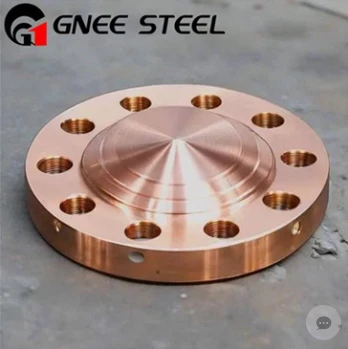
In industrial classification, pure copper is often divided into oxygen-free copper (OF-Cu), low-oxygen copper and high-oxygen copper according to oxygen content.
Oxygen-free copper with oxygen content below 5 ppm has the best conductivity, thermal conductivity, plasticity and welding performance, and is used in high-end electronics, aerospace and communication fields. Low-oxygen copper is widely used in daily wires, cables and hardware due to its moderate cost and performance. High-oxygen copper is only used in occasions with low requirements for processing and conductivity, such as some casting parts.
In summary
Oxygen is a double-edged element in pure copper. Excessive oxygen will damage electrical conductivity, thermal conductivity, plasticity, welding performance and corrosion resistance, while ultra-low oxygen is the key to ensure high-performance copper. In production and application, accurately controlling oxygen content is an important means to balance cost, performance and service life of pure copper materials.



