


High-pressure oxygen piping belongs to high-risk fluid systems. Improper alloy selection may trigger ignition, combustion or even pipe rupture. Monel 400 and Inconel 600 are two widely specified nickel-based alloys for oxygen service, but their combustion resistance, allowable working pressure and applicable temperature ranges differ greatly.
Wrong Material Selection Under High‑Pressure Oxygen Service May Lead to Catastrophic Consequences
Oxygen does not burn itself, but it accelerates combustion of metals and organic contaminants. In oxygen piping systems, ignition risks concentrate at throttling points, elbows, dead legs and particle impact zones. Once combustion occurs, nickel alloy components can suffer rapid failure. Alloy flame resistance is a core index for oxygen system design, not only tensile strength or corrosion resistance.
Composition Defines Material Properties: Nickel‑Copper vs. Nickel‑Chromium
Monel 400 (UNS N04400) is a nickel‑copper solid solution alloy. Its main alloying elements are Ni and Cu, with low chromium content. Available product specifications include ASTM B165 seamless tube, ASTM B164 plate, bar and forging.
Inconel 600 (UNS N06600) is nickel‑chromium‑iron alloy. It contains higher chromium and iron content. Applicable standards: ASTM B167 seamless tube, ASTM B168 plate and sheet.
Mechanical Properties: Inconel 600 Offers Higher Strength
Mechanical data below refers to annealed delivery condition at room temperature.
| Parameter | Monel 400 UNS N04400 | Inconel 600 UNS N06600 |
|---|---|---|
| Tensile Strength, min | 480 MPa | 552 MPa |
| 0.2% Offset Yield Strength, min | 170 MPa | 240 MPa |
| Elongation, min | 35% | 30% |
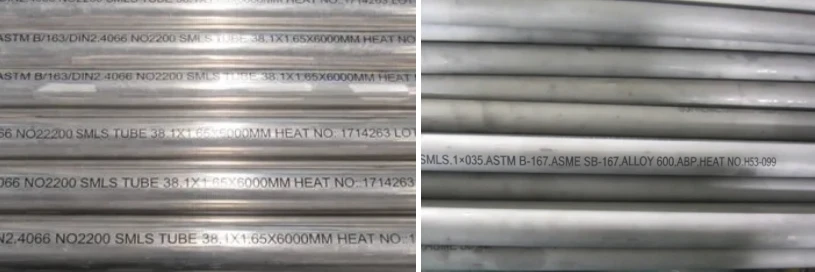
Core Indicators in Oxygen Service: Flame Resistance and Allowable Exemption Pressure
Exemption pressure means the pressure threshold where the material is accepted for oxygen service under defined velocity limits. This value cannot be separated from oxygen flow velocity. Higher flow velocity reduces allowable working pressure.
Monel 400 is generally approved for service up to 21 MPa (approximately 210 bar), subject to strict oxygen‑flow‑velocity limits defined in ASTM G88 and AIGA 021/05. It has low heat of combustion and slow flame propagation, making it the preferred choice for high-pressure oxygen piping.
Inconel 600 has higher chromium‑oxide heat‑of‑formation. Its exemption pressure is capped near 7 MPa. It is not recommended for high-pressure oxygen service above this threshold, though it works well for medium-low pressure oxygen systems with elevated operating temperature.
Monel 400 VS Inconel 600 Oxygen‑Service Performance Summary Table
| Parameter | Monel 400 UNS N04400 (ASTM B165 / B164) | Inconel 600 UNS N06600 (ASTM B167 / B168) |
|---|---|---|
| Base Alloy System | Nickel‑Copper | Nickel‑Chromium‑Iron |
| Approx Exemption Pressure(O₂>93%, limited by flow velocity) | Up to 21 MPa | ≤7 MPa |
| Tensile Strength (Annealed) | ≥480 MPa | ≥552 MPa |
| Yield Strength (0.2% offset) | ≥170 MPa | ≥240 MPa |
| Elongation | ≥35 % | ≥30 % |
| Max continuous operating temperature | ≤480 °C | ≤1090 °C |
| Oxygen‑combustion characteristic | Low heat of combustion, slow flame propagation | Higher chromium‑oxide heat‑of‑formation, higher ignition risk |
| Primary applicable scenario | High‑pressure high‑purity oxygen piping, valve trim | Medium‑low‑pressure oxygen with elevated service temperature |
Note: Exemption pressure is strictly subject to oxygen flow velocity per ASTM G88 / AIGA 021‑05. Higher flow velocity reduces allowable working pressure.
Dissimilar‑metal Joint Risk Between Monel 400 and Inconel 600
When Monel 400 and Inconel 600 are electrically coupled under humid or condensing oxygen‑system environment, galvanic corrosion risk occurs due to different electrochemical potentials.
Even for oxygen‑service equipment, condensation can form electrolyte on joint surfaces during shutdown cycles. Mitigation options: Use insulating gaskets; apply qualified dissimilar‑metal welding procedure with nickel‑base filler metal ERNiCu‑7; avoid direct metal‑to‑metal contact where condensation may happen.
Division of Roles in Practical Applications
Monel 400 is widely adopted in high-pressure oxygen pipelines, oxygen compressor parts and valve trim. Its low combustion risk is the primary advantage for high-pressure oxygen systems.
Inconel 600 is selected when the system needs both oxygen compatibility and high-temperature oxidation resistance. It is suitable for medium-low pressure oxygen equipment with working temperature above 500°C, such as oxygen heating furnace pipelines.
Mandatory Degreasing
All oxygen wetted surfaces must complete professional oxygen cleaning before assembly. Oxygen‑system cleaning shall follow ASTM G93/G93M standard for cleanliness verification. Residual hydrocarbon limit ≤10 mg/m² corresponds roughly to Cleanliness Level B. Cleaning solvent must be halogen‑free. Solvent‑extraction testing is required for final validation. Visual inspection alone cannot guarantee oxygen‑service cleanliness.
Organic residues such as grease, oil and wax are the main ignition sources in oxygen piping, even if the base alloy itself is oxygen-compatible.
Common Mis‑selection Pitfalls for Oxygen‑Piping Projects
- Only consider mechanical strength and ignore oxygen‑compatibility; selecting Inconel 600 purely for higher tensile strength for >10 MPa high‑pressure oxygen lines.
- Misunderstanding exemption pressure as absolute safety value, ignoring flow‑velocity constraints per ASTM G88.
- Assuming nickel‑base alloy eliminates all fire risk: organic contamination still remains the top ignition source.
- Direct metal‑to‑metal assembly between Monel 400 and Inconel 600 without insulation, risking galvanic corrosion under condensation condition.
- Skipping third‑party cleanliness inspection after oxygen‑degreasing process.
RFQ Checklist for Oxygen‑Service Nickel Alloy Components
- Specify UNS grade, full ASTM product standard (distinguish pipe / plate / forging)
- Define design working pressure, maximum oxygen flow velocity, operating‑temperature range
- Required oxygen‑cleaning standard: ASTM G93 cleanliness level, third‑party cleanliness‑verification requirement
- NDT scope: PMI, hydro‑test, UT / PT where applicable
- Certificate requirement: EN 10204 3.1 / 3.2 with full heat‑lot traceability
- Additional requirement: packaging to preserve oxygen‑clean surface during transit
If you have oxygen‑piping material‑selection questions, submit your design parameters and component drawings. Our metallurgy team can review material fitness for your high‑risk oxygen‑service project.


Request Oxygen‑Service Material Evaluation
Conclusion: How to Make the Selection?
For high-pressure oxygen service over 7 MPa, Monel 400 is the preferred option, subject to velocity control and oxygen cleaning. For medium-low pressure oxygen systems with high operating temperature, Inconel 600 can be evaluated.
Alloy grade is only one part of system safety. Flow velocity, filters, seals and dead leg design also determine overall oxygen system risk. All final material selection must be reviewed by your project metallurgy and safety team.

FAQ:
Q1: Can Inconel 600 be used for 15 MPa high‑pressure oxygen piping?
A1: Not recommended per AIGA‑021‑05 guidance. Inconel 600's exemption pressure is capped near 7 MPa. Higher‑pressure oxygen service prefers Monel 400.
Q2: Can Monel 400 and Inconel 600 be welded together for oxygen‑system components?
A2: Welding is feasible with ERNiCu‑7 filler metal. Beware of galvanic‑corrosion risk if condensation occurs at joint during system shutdown cycles. Insulating measures shall be considered.
Q3: Does high‑quality nickel alloy remove requirement for oxygen‑degreasing?
A3: No. Even flame‑resistant Monel 400 still requires full oxygen‑cleaning following ASTM G93. Organic contaminations are primary ignition trigger regardless of base‑metal grade.
Q4: What alternative alloys can be evaluated for oxygen‑service application?
A4: Copper‑base alloys, Nickel 200/201 are also well‑recognized for oxygen‑compatible service under defined pressure‑velocity limits.



