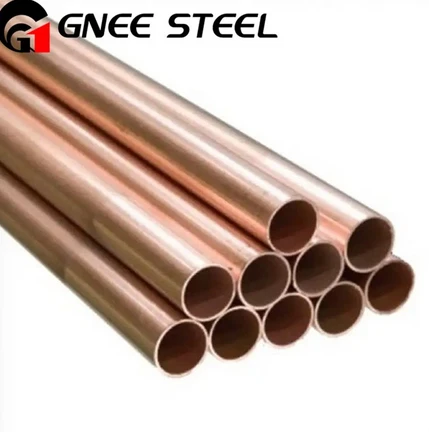
1: What is CuNi 70/30 alloy, and what are its defining properties that make it indispensable for marine and offshore applications?
CuNi 70/30, also known as UNS C71500, is a copper-nickel alloy composed of approximately 70% copper and 30% nickel, with small, controlled additions of iron and manganese. This specific composition is engineered to deliver a combination of properties unmatched by many other metals in aggressive environments.
Its indispensability in marine and offshore sectors stems from three core properties:
Exceptional Corrosion and Erosion Resistance: This is its paramount attribute. The alloy forms a tight, adherent, and self-repairing protective oxide film when exposed to seawater. This film is highly resistant to a wide range of corrosive threats, including:
General and pitting corrosion in stagnant or flowing seawater.
Stress corrosion cracking (SCC) under tensile loads.
Impingement and erosion-corrosion from high-velocity water, sand, or suspended solids. The addition of iron (0.4-1.0%) is critical here, dramatically enhancing resistance to high-flow conditions.
Macro-fouling and microbiologically influenced corrosion (MIC): CuNi 70/30 has inherent biocidal properties, discouraging the attachment of barnacles, mussels, and sulfate-reducing bacteria (SRB), reducing maintenance and preserving hydrodynamic efficiency.
Excellent Fabricability and Weldability: Despite its high strength, it can be hot- and cold-worked, formed, and bent. It is readily welded using Gas Tungsten Arc Welding (GTAW/TIG) and Gas Metal Arc Welding (GMAW/MIG) with matching filler metals (e.g., ERCuNi), resulting in weld joints with corrosion resistance matching the parent metal.
High Thermal Conductivity and Strength Retention: It maintains excellent mechanical properties (tensile strength, fatigue resistance) at both elevated and cryogenic temperatures, making it suitable for heat exchangers in power generation and systems handling LNG.
2: Why is the "seamless" manufacturing process critical for CuNi 70/30 pipes used in high-integrity systems like seawater cooling and hydraulic lines?
The seamless manufacturing process, typically through extrusion or piercing of a solid billet, is non-negotiable for critical pressure-containing applications for several reasons:
Structural Integrity and Homogeneity: A seamless pipe has a uniform, continuous grain structure around its entire circumference. There is no longitudinal weld seam, which is a potential inherent weak point. This eliminates the risk of weld defects (incomplete penetration, porosity, slag inclusions) in the pipe body itself, ensuring consistent mechanical properties throughout.
Superior Pressure Containment: The absence of a weld seam means the pipe has a uniform wall thickness and strength distribution. It can withstand higher internal pressures and is less susceptible to fatigue failure from pressure cycling, a common occurrence in shipboard systems.
Enhanced Corrosion Resistance: A weld seam, even if perfectly executed, creates a metallurgically different zone (Heat-Affected Zone - HAZ) with potentially varying corrosion resistance. In a seamless pipe, the entire body is homogenous, ensuring the protective oxide film forms uniformly. This is vital for handling corrosive seawater where pitting at a weld seam could lead to catastrophic failure.
Reliability in Dynamic Environments: Offshore and marine systems are subject to vibration, thermal cycling, and mechanical stress. The monolithic structure of a seamless pipe offers superior resistance to crack initiation and propagation compared to a welded counterpart, guaranteeing long-term, maintenance-free service.
3: In seawater system design, what are the critical velocity limits for CuNi 70/30 pipe, and what happens if these limits are exceeded?
While CuNi 70/30 is renowned for its erosion-corrosion resistance, it is not immune to damage under excessively high flow velocities. Adhering to design velocity limits is crucial for system longevity.
Recommended Design Limit: The generally accepted safe, continuous design velocity for clean seawater in CuNi 70/30 systems is 3.5 to 4.0 meters per second (11.5 - 13 ft/s).
Maximum Allowable Velocity: For short-term or intermittent conditions (e.g., pump surge), velocities up to 6 m/s (20 ft/s) may be tolerated in systems free of abrasive solids.
Critical Effect of Solids: The presence of sand or suspended solids (silt) is a primary accelerant of erosion. Even at velocities below 3 m/s, a high concentration of abrasives can cause significant wall thinning, especially at bends, elbows, and reducers.
Consequences of Exceeding Limits:
Mechanical Erosion: High kinetic energy of water molecules physically wears away the protective oxide film faster than it can reform.
Cavitation: In areas of sudden pressure change (e.g., after a valve or pump), vapor bubbles can form and implode against the pipe wall with tremendous force, causing localized pitting and material loss. This is distinct from, but often accompanies, high-velocity erosion.
Flow-Accelerated Corrosion (FAC): The combined chemical (corrosion) and mechanical (erosion) action leads to accelerated, localized wall thinning. This can lead to leaks, pipe failure, and the injection of metal ions into the system, which is undesirable for environmental and operational reasons.
System design must therefore include proper pump selection, pipe sizing, and the specification of cyclone separators or filters in sandy or silty water conditions.
4: What are the essential procedures and consumables for successfully welding CuNi 70/30 seamless pipe, and what common pitfalls must be avoided?
Welding CuNi 70/30 requires strict procedure control to preserve its corrosion resistance.
Essential Procedures & Consumables:
Filler Metal: Must use nickel-based overmatching filler metals. ERNiCu-7 (Monel 60) is the industry standard. It provides a weld deposit with higher nickel content than the base metal, ensuring the weld metal corrosion resistance equals or exceeds that of the CuNi 70/30 pipe. Using a copper-based filler can create galvanic cells.
Joint Preparation & Cleaning: Impeccable cleanliness is vital. All oxides, grease, and dirt must be removed from the joint area using stainless steel brushes (dedicated to CuNi) and solvents. Oxides can lead to lack of fusion and porosity.
Preheat and Interpass Temperature: Preheat is generally not required for thin walls but is recommended for thick sections (>15mm) to prevent cracking. Crucially, interpass temperature must be controlled below 150°C (300°F). Excessive heat input can lead to hot cracking and grain growth in the HAZ, degrading properties.
Shielding Gas: Use high-purity argon (or Ar/He mixes for better penetration on thicker sections). Excellent gas coverage on both the front and back (back-purging) of the weld is mandatory to prevent oxidation (sugaring) on the root pass interior.
Common Pitfalls to Avoid:
Contamination: The most critical error. Using tools, brushes, or worktables contaminated with carbon steel, aluminum, or other metals can lead to galvanic pitting and weld defects. Dedicate tools for CuNi work.
Excessive Heat Input: High amperage or slow travel speed raises interpass temperature, promoting cracking and reducing corrosion resistance.
Ignoring Back Purging: Failure to back purge results in a heavily oxidized, brittle, and non-corrosion-resistant root bead, compromising the entire system's integrity.
Post-Weld Heat Treatment (PWHT): PWHT is neither required nor recommended for CuNi 70/30. It can cause excessive grain growth and precipitate harmful phases, reducing toughness and corrosion resistance.
5: Beyond marine seawater systems, what are other key industrial applications for CuNi 70/30 seamless pipe, and what drives its selection in these challenging environments?
The unique property profile of CuNi 70/30 makes it a premium material solution in several other demanding industries:
Offshore Oil & Gas - Process and Utility Systems: Used in:
Firewater and Deluge Systems: Reliability is paramount for safety-critical systems. Its corrosion and fouling resistance ensures nozzles remain clear and pipes intact.
Process Cooling Water: Handles produced water (often saline and sour) in heat exchangers and coolers.
Hydraulic & Instrumentation Lines: For subsea control systems where reliability over a 25+ year design life is essential.
Power Generation - Condenser and Auxiliary Cooling Tubes: In coastal or estuarine power plants, it is the material of choice for surface condensers and auxiliary coolers handling brackish or full-strength seawater, offering a long service life and high thermal efficiency.
Desalination Plants - Heat Rejection and Brine Handling: In Multi-Stage Flash (MSF) and Thermal Vapor Compression (TVC) plants, it is used in heat rejection sections and for handling hot, concentrated brine-an extremely aggressive environment where it outperforms stainless steels.
Chemical and Petrochemical Processing: Selected for handling chlorides, alkalis, and non-oxidizing acids (e.g., hydrochloric, sulfuric) where stainless steels would suffer from pitting or SCC. Its non-sparking property is also a safety benefit in hazardous areas.
The Selection Driver across all these applications is Total Life Cycle Cost. While the initial material cost of CuNi 70/30 is high, its unparalleled resistance to corrosion, erosion, and biofouling translates into decades of reliable service with minimal maintenance, downtime, or risk of failure. This often makes it the most economical choice over the lifespan of a critical industrial asset.