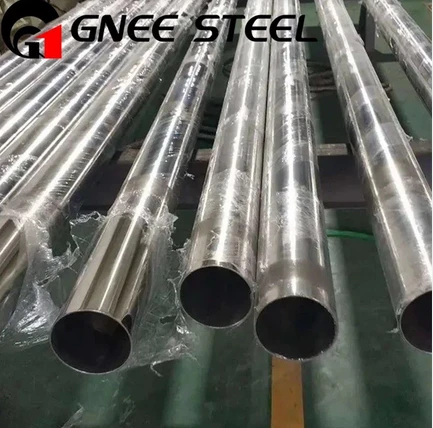
1. What is the significance of the designation "1.4507" for Nickel 200, and how does it relate to common standards like UNS N02200?
The designation "1.4507" is a German material number (Werkstoffnummer) from the DIN standard. It is the European equivalent designation for the alloy commonly known in the U.S. as Nickel 200 (UNS N02200).
UNS N02200: This is the Unified Numbering System code, widely used in North America and internationally for specifying the chemical composition of Nickel 200.
DIN 2.4060 / 1.4507: This is the European designation. While sometimes used interchangeably, they precisely identify the same commercially pure nickel alloy (99.6% Ni min).
Therefore, a pipe specified as "Nickel 200 1.4507" indicates that the material conforms to the European DIN standard, guaranteeing the same fundamental properties as UNS N02200: excellent corrosion resistance in specific media, high ductility, and good electrical and thermal conductivity.
2. In a caustic soda (NaOH) evaporation plant, why is a seamless Nickel 200 (1.4507) pipe a superior choice for transfer lines over standard stainless steel pipes?
The performance gap in caustic service is dramatic and is due to the fundamental corrosion mechanisms at play.
Failure of Stainless Steels (e.g., 316L): Stainless steels rely on a passive chromium oxide layer for protection. In hot, concentrated caustic environments, this layer is unstable. More critically, stainless steels are highly susceptible to Caustic Stress Corrosion Cracking (SCC), a catastrophic and unpredictable failure mode where cracks propagate under the combined action of the caustic and tensile stress.
Superiority of Nickel 200 (1.4507):
Inherent Immunity: Nickel metal is thermodynamically stable in alkaline (caustic) environments. Nickel 200 does not rely on a passive film in the same way, making it inherently immune to caustic SCC.
Proven Performance: It is the benchmark material for handling all concentrations of sodium hydroxide, up to and including the molten state, at high temperatures.
Reliability: A seamless Nickel 200 pipe ensures a homogeneous, defect-free structure with no welds along its length, providing the most reliable containment for aggressive hot caustic.
Using Nickel 200 pipe eliminates the risk of unplanned shutdowns due to pipe failure, ensuring long-term, safe operation of the evaporation plant.
3. What is the critical temperature limitation for using Nickel 200 (1.4507) pipe in structural or pressure-containing applications, and why?
The critical temperature limitation for Nickel 200 in structural service is approximately 315°C (600°F).
The Reason: Graphitization (Intergranular Embrittlement)
Nickel 200 has a maximum carbon content of 0.15%. When exposed to temperatures above 315°C for prolonged periods, this carbon becomes mobile and precipitates out of the solid solution as graphite. This graphite forms a continuous, brittle network along the grain boundaries of the metal.
Consequence:
This process severely reduces the material's ductility and impact toughness. A pipe in this embrittled condition can suffer catastrophic brittle fracture under operational stress or thermal shock, even if the stress level is within the design limit at room temperature.
Solution:
For services above 315°C, the low-carbon variant, Nickel 201 (UNS N02201 / DIN 2.4061), with a max carbon content of 0.02%, must be specified. Nickel 201 is immune to this form of embrittlement.
4. From a fabrication standpoint, what are the key considerations for welding a Nickel 200 (1.4507) piping system?
Welding Nickel 200 requires specific procedures to achieve sound, corrosion-resistant joints. The primary challenges are its high thermal expansion, low penetration, and susceptibility to contamination.
Cleanliness is Paramount: All surfaces (pipe ends, filler metal) must be meticulously cleaned of contaminants like sulfur, phosphorus, lead, oil, and grease. These elements can cause embrittlement and weld defects.
Filler Metal Selection: Use a matching filler metal, such as EL-Ni 99.2 (SF-Ni 1 according to DIN 1736) or ERNi-1 (AWS A5.14). This ensures the weld metal has corrosion resistance similar to the base pipe.
Joint Design & Technique:
Use a wider groove angle than for steel to compensate for nickel's poorer weld pool fluidity.
Employ Gas Tungsten Arc Welding (GTAW/TIG) for the root and hot passes for best control.
Use stringer beads (no weaving) and control interpass temperature to minimize heat input and prevent excessive grain growth.
Back Purging: The use of an inert backing gas (e.g., Argon) on the inside of the pipe is essential to prevent oxidation of the root bead, which would compromise corrosion resistance.
5. In a lifecycle cost analysis for a chemical processing unit, how does selecting Nickel 200 (1.4507) piping provide a better economic case than a cheaper, lined alternative?
While the initial cost of solid Nickel 200 pipe is high, its Total Cost of Ownership (TCO) is often lower for critical services due to unparalleled reliability and safety.
The Risks of Lined Pipe (e.g., Steel with a Plastic or Rubber Liner):
Mechanical Damage: The liner can be punctured, scratched, or delaminated during installation or operation.
Permeation & Failure: Aggressive chemicals can permeate some liners, attacking the carbon steel shell from behind and causing sudden failure.
Temperature and Pressure Limits: Liners have strict operational envelopes that can be exceeded during process upsets.
The Value Proposition of Solid Nickel 200 Pipe:
Absolute Integrity: It provides a homogeneous, full-barrier protection. There is no liner to fail, eliminating the risk of a leak path.
Elimination of Catastrophic Downtime: A leak in a chemical transfer line can force a full plant shutdown. The revenue loss from unplanned downtime can be millions of dollars per day, far outweighing the initial pipe cost.
Longer Service Life: A Nickel 200 system can last for decades with minimal degradation. Lined systems often require more frequent inspection and replacement.
Broader Operational Envelope: It can handle higher temperatures, pressures, and mechanical abuse than most lined alternatives.
Conclusion: For a critical, corrosive service like caustic or halogen transfer, the investment in solid Nickel 200 (1.4507) pipe is justified by its role as a risk-mitigation strategy, ensuring continuous, safe operation and a lower TCO.