In the heat treatment and aerospace industries, GH3030 and GH3039 are the mainstays in the 800°C-900°C temperature range.
At Gnee Alloy, we help you define precise technology boundaries to ensure your equipment achieves the highest industrial durability.
Click to get a GH3030 product quote
GH3030 and GH3039 Pipes: Performance Comparison

GH3030 and GH3039 Pipes: Performance Comparison
Both GH3030 and GH3039 are nickel-chromium solid solution strengthened superalloys suitable for high-temperature applications. GH3030 is an earlier 80/20 nickel-chromium alloy, best suited for temperatures below 800°C. GH3039 is an advanced derivative alloy with added elements, allowing it to maintain its strength and oxidation resistance at temperatures up to 1000-1100°C.
What are the components of GH3030?
GH3030 is a solid solution strengthened high-temperature alloy, mainly composed of nickel (Ni) and chromium (Cr), with a simple chemical composition. Its typical ratio is 80% nickel and 20% chromium.

1. Comparison of chemical composition of GH3030 and GH3039 (wt%)
| Element | GH3030 | GH3039 | Key Difference |
|---|---|---|---|
| Nickel (Ni) | Balance (≥ 75.0) | Balance (≥ 65.0) | GH3030 has higher Ni |
| Chromium (Cr) | 19.0 – 22.0 | 19.0 – 22.0 | Identical |
| Iron (Fe) | ≤ 1.5 | ≤ 3.0 | GH3039 allows more Fe |
| Molybdenum (Mo) | – | 1.80 – 2.30 | GH3039 contains Mo |
| Niobium (Nb) | – | 0.90 – 1.30 | GH3039 contains Nb |
| Titanium (Ti) | 0.15 – 0.35 | 0.35 – 0.75 | GH3039 has higher Ti |
| Aluminum (Al) | ≤ 0.15 | 0.35 – 0.75 | GH3039 contains Al |
| Carbon (C) | ≤ 0.12 | ≤ 0.08 | GH3039 has lower C |
| Manganese (Mn) | ≤ 0.70 | ≤ 0.40 | GH3030 higher |
| Silicon (Si) | ≤ 0.80 | ≤ 0.80 | Same |
| Phosphorus (P) | ≤ 0.030 | ≤ 0.020 | GH3039 stricter |
| Sulfur (S) | ≤ 0.020 | ≤ 0.012 | GH3039 stricter |
| Copper (Cu) | ≤ 0.20 | ≤ 0.20 | Same |
| Cerium (Ce) | – | Allowed (trace) | GH3039 may contain Ce |
2. Comparison of room temperature mechanical properties of GH3030 and GH3039
| Property | GH3030 (Annealed) | GH3039 (Solution Treated) | Advantage |
|---|---|---|---|
| Tensile Strength, Ultimate (MPa) | ≥ 685 (99 ksi) | ≥ 735 (107 ksi) | GH3039 (~7% higher) |
| Tensile Strength, Yield (MPa) | ≥ 295 (43 ksi) | Not specified* | GH3030 has clear yield point |
| Elongation (%) | ≥ 30 | ≥ 40 | GH3039 |
| Reduction of Area (%) | ≥ 50 | – | – |
| Hardness (HBW) | ≤ 200 | Not specified | – |
| Modulus of Elasticity (GPa) | ~210 | ~196 | GH3030 stiffer |
| Density (g/cm³) | 8.4 | 8.3 | GH3039 slightly lighter |
Click to download the GH3030 alloy PDF file now
3. Comparison of high-temperature mechanical properties of GH3030 and GH3039
| Temp (°C) | Property | GH3030 | GH3039 |
|---|---|---|---|
| 500 | Tensile (MPa) | ~600 | ~650 |
| Yield (MPa) | ~280 | ~400 | |
| 600 | Tensile (MPa) | ~550 | ~600 |
| Yield (MPa) | ~260 | ~380 | |
| 700 | Tensile (MPa) | ~450 – 500 | ~550 |
| Yield (MPa) | ~240 | ~360 | |
| 800 | Tensile (MPa) | ~300 – 380 | ~450 |
| Yield (MPa) | ~180 | ~300 | |
| 900 | Tensile (MPa) | ~200 – 250 | ~350 |
| Yield (MPa) | ~120 | ~240 |
4. Comparison of physical properties of GH3030 and GH3039
| Property | GH3030 | GH3039 |
|---|---|---|
| Density (g/cm³) | 8.4 | 8.3 |
| Melting Range (°C) | 1374 – 1420 | 1352 – 1375 (approx.) |
| Thermal Conductivity (20°C) (W/m·K) | 14 – 15 | ~14.5 |
| CTE (20-100°C) (10⁻⁶/°C) | 12.8 | 11.5 |
| CTE (20-800°C) (10⁻⁶/°C) | ~16.0 | ~15.5 |
| Specific Heat (20°C) (J/kg·K) | 460 – 500 | ~500 |
| Electrical Resistivity (µΩ·m) | 1.20 – 1.30 | ~1.25 |
| Magnetic Properties | Non-magnetic | Non-magnetic |
5. GH3030 and GH3039 Application Selection Guide
Choose GH3030 Seamless Pipes if: You are building simple industrial furnace liners, radiant tube baffles, heating element supports, and static aerospace parts operating strictly below 800°C. It is the most Cost-effective Solution for basic heat service.


Upgrade to GH3039 Seamless Pipes if: You are designing aero-engine combustion liners, high-temperature heat exchangers, or furnace muffles exposed to 900°C. It is mandatory for parts requiring high Structural Integrity under constant thermal cycling.


Why Choose Gnee as Your Nickel-Based Alloy Supplier
✅️VIM + ESR Melting: We utilize dual-vacuum refining to ensure ultra-low trace impurities, which is the key to maximizing the thermal fatigue resistance of GH3039.
✅️Direct Factory Price: Eliminate middleman markups while securing Aerospace Grade quality.
✅️Wholesale Inventory: Massive stock of GH3030 and GH3039 tubing and sheets ready for Fast Global Shipping.
✅️MTC 3.1 Traceability: Full heat-analysis and mechanical test reports included with every shipment.

Gnee Alloy GH3030 Certificate
📦 Packaging and Shipping
All Nickel Based Alloy products are packaged using the following methods:
Wooden pallets or crates
Moisture-proof packaging
Labels with furnace number, standard, and size labels
Shipped worldwide by sea, air, or express
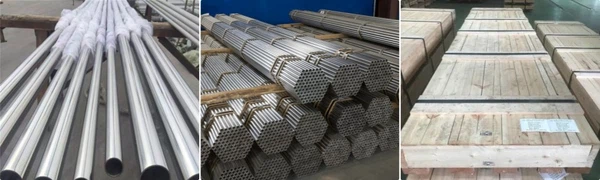
Gnee Alloy GH3030 Product Packing
Contact us for the latest export price quote for GH3030 Alloy
FAQ
Q1: Can I weld GH3030 and GH3039 together in a hybrid manifold?
A: Yes. Both have excellent metallurgical compatibility. We recommend using ERNiCr-3 filler metal. However, please note that the maximum operating temperature of the entire joint will be limited by the GH3030 side (800°C).
Q2: Is GH3039 harder to machine than GH3030?
A: Slightly. The addition of Mo and Al increases the work-hardening rate. However, as a Manufacturer, we supply pipes in an optimized solution-annealed state to ensure your machining costs remain manageable.
Q3: Why is GH3039 more expensive per kg?
A: Molybdenum is an expensive strategic metal. The addition of Mo and Al, combined with more precise heat treatment requirements, increases the manufacturing cost but results in a significantly lower Total Cost of Ownership due to the longer part life.
Q4: Can you provide bright annealed GH3039 tubing for precision instruments?
A: Absolutely. We offer Bright Annealed (BA) precision tubing with Ra ≤ 0.4μm finish, ensuring zero internal oxidation scale for sensitive sensors.