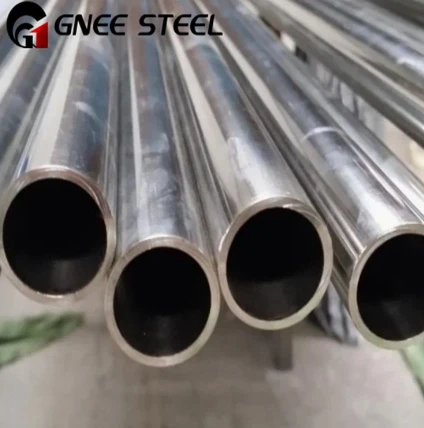
1. Among the wide range of alloys listed (Incoloy 800, Inconel 625/718/725, Hastelloy C-276/C-22/C-4, Hastelloy X), what are the fundamental metallurgical principles for selecting a specific alloy for a cold-drawn, seamless tube or rectangular pipe in high-temperature service versus severe aqueous corrosion service?
The selection hinges on the primary environmental driver: high-temperature strength and oxidation resistance versus ambient-to-moderate temperature aqueous corrosion resistance. These properties are dictated by the alloy's base matrix and key strengthening/corrosion-inhibiting elements.
For High-Temperature Service (e.g., heat exchangers, furnace components):
Principle: Strength is derived from solid solution strengthening and/or precipitation hardening. Oxidation resistance is provided by forming a stable, continuous, and slow-growing chromium oxide (Cr₂O₃) scale.
Alloy Examples & Mechanisms:
Incoloy 800/800H: An iron-nickel-chromium alloy. Its high-temperature strength comes from its solid-solution strengthened austenitic matrix. Its excellent oxidation and carburization resistance up to ~1100°C is due to its ~21% Cr content and nickel stability.
Inconel 718/725: Nickel-chromium alloys strengthened by gamma prime and gamma double prime precipitates (Ni₃(Al, Ti, Nb)). These precipitates provide exceptional tensile and creep strength up to ~650°C (718) and higher for 725, making them ideal for high-pressure, high-stress tubing. Chromium (~19%) provides oxidation resistance.
Hastelloy X: A nickel-chromium-iron-molybdenum alloy optimized for oxidation resistance up to 1200°C. Its strength is solid-solution based, with molybdenum providing strengthening. It forms a protective Cr₂O₃ scale and is used in combustor liners and high-temperature heat exchangers.
For Severe Aqueous Corrosion Service (e.g., chemical processing, FGD, nuclear reprocessing):
Principle: Resistance is provided by passivation-forming a durable, adherent, and rapidly self-repairing passive film, primarily of chromium oxide, but significantly enhanced by molybdenum and tungsten for localized corrosion resistance.
Alloy Examples & Mechanisms:
Hastelloy C-276/C-22/C-4: Nickel-chromium-molybdenum alloys. Molybdenum (>13%) is the key for resisting localized pitting and crevice corrosion in chloride environments. Chromium (~16-22%) handles oxidizing conditions. Their "low-iron" composition minimizes harmful phase formation. C-22's balanced Cr/Mo/W offers the widest corrosion range; C-276 is the industry benchmark; C-4 offers superior thermal stability for specific acid services.
Inconel 625: While also a Ni-Cr-Mo alloy, its high niobium content provides solid-solution strengthening and excellent resistance to chloride-induced stress corrosion cracking (SCC) and a broad range of acids. It bridges high-strength and corrosion-resistant applications.
Conclusion: For a tube, one must first define the dominant threat: loss of strength/creep at temperature, or thinning/localized attack from corrosion. This dictates the alloy family, after which specific chemistry (C-22 vs. C-276) is chosen based on the exact process stream.
2. The specification mentions "Cold Drawn 32x3" dimensions. What are the specific advantages of the cold drawing process for manufacturing seamless tube and rectangular pipe from these high-performance alloys, and what critical post-processing steps are required?
Cold drawing is a precise, room-temperature metal forming process where a tube shell (pierced billet) is pulled through a die and over a mandrel to achieve the final dimensions, wall thickness, and shape (round or rectangular).
Advantages for High-Performance Alloys:
Superior Surface Finish & Dimensional Tolerance: Cold drawing produces an exceptionally smooth, defect-free internal and external surface (ideal for preventing corrosion initiation or fouling) with very tight tolerances on OD, ID, and wall thickness (e.g., ±0.1mm). This is crucial for precision heat exchanger tubes and instrument piping.
Enhanced Mechanical Properties: The process induces significant cold work, which increases the tensile and yield strength of the material through work hardening. This allows the finished tube to meet specified minimum mechanical properties without a final heat treatment in some cases, or to achieve higher strengths in tempers like "half-hard" or "full-hard."
Ability to Form Complex Shapes: It is the primary method for producing seamless rectangular or square pipe from these alloys, which are often used in structural components of furnaces or for specific fluid flow characteristics.
Material Conservation: It is a near-net-shape process, minimizing machining waste of expensive alloy stock.
Critical Post-Processing Steps:
Heat Treatment (Annealing): After cold drawing, the material is in a heavily stressed, work-hardened state with reduced ductility and potentially altered corrosion resistance. A full solution anneal is almost always required. For alloys like C-276, this involves heating to ~1120°C followed by rapid quenching to re-dissolve any precipitated phases and restore the optimal corrosion-resistant microstructure. For precipitation-hardening alloys like 718, a more complex aging heat treatment follows solution annealing.
Pickling & Passivation: The annealing process creates a heavy oxide scale. The tube must undergo pickling in an acid bath (HNO₃/HF for nickel alloys) to remove this scale, followed by passivation to restore the uniform, protective chromium oxide layer on the surface.
Final Cold Sizing/Straightening: A very light final draw or rotary straightening may be used after annealing to meet final dimensional and straightness specifications without significantly re-introducing harmful cold work.
3. For a rectangular pipe made from Hastelloy C-276 destined for a scrubber unit in a Flue Gas Desulfurization (FGD) system, what specific corrosion mechanisms is it designed to combat, and why would a rectangular shape be specified over round tubing?
An FGD scrubber environment is arguably one of the most complex and aggressive industrial corrosion environments, often described as a "chloride acid soup."
Corrosion Mechanisms Combated by C-276:
Pitting and Crevice Corrosion: The hot, acidic scrubber slurry is saturated with chlorides from seawater or coal. C-276's high molybdenum content (~16%) gives it an extremely high Pitting Resistance Equivalent Number (PREN), allowing it to withstand pitting attack where stainless steels would fail rapidly.
Sulfuric & Hydrochloric Acid Corrosion: The process generates sulfuric acid (H₂SO₄) and often hydrochloric acid (HCl). C-276 offers excellent resistance across a wide range of concentrations and temperatures for these reducing acids.
Oxidizing Acid & Salt Attack: The presence of oxygen, ferric ions (Fe³⁺), or cupric ions (Cu²⁺) can create localized oxidizing conditions. C-276's chromium content (~16%) provides stability in these environments.
Stress Corrosion Cracking (SCC): The combination of chlorides, acidity, and residual tensile stresses (from welding or forming) is a classic SCC scenario. C-276 is one of the few alloys proven to have virtual immunity to chloride-induced SCC.
Rationale for Rectangular Pipe Shape:
A rectangular pipe (or "box section") is often specified for structural and design efficiency within the scrubber module:
Maximized Use of Space: Rectangular sections can be packed more efficiently against the walls of a large, rectangular scrubber tower or used as internal support beams, providing greater structural rigidity per unit of envelope space compared to round pipes.
Ease of Integration & Fabrication: Flat surfaces are easier to weld to other flat plates or supports (e.g., for attaching spray headers, mist eliminator supports, or wear plates) without complex contouring.
Fluid Dynamics: In some applications, like ductwork or distribution channels, a rectangular cross-section can provide more uniform flow distribution.
4. Considering the seamless tubing made from precipitation-hardenable alloys like Inconel 718 and 725, what is the sequence of manufacturing and heat treatment required to achieve their specified high strength, and what are the critical quality control checks on the final tube?
The manufacturing of high-strength precipitation-hardenable (PH) alloy tubing is a multi-step, tightly controlled process.
Typical Manufacturing & Heat Treatment Sequence:
Hot Working: The alloy ingot is homogenized, then forged/extruded and hot-rolled to form a seamless tube shell.
Cold Drawing: The tube shell is cold drawn to the near-final size, building in cold work.
Solution Annealing: The tube is heated to a high temperature (~980°C for Alloy 718) to dissolve all alloying elements (Nb, Ti, Al) into a uniform solid solution and to recrystallize the grain structure. It is then rapidly quenched (typically water) to retain this supersaturated state at room temperature. At this stage, the material is relatively soft and ductile for final forming.
Final Cold Sizing: A light final cold draw may be used to achieve exact dimensions and improve surface finish.
Precipitation Hardening (Aging): This is the critical strengthening step. The tube is heated to an intermediate temperature (~720°C for 718, ~705°C for 725) and held for a precise time (often 8 hours for 718, then furnace cool to ~620°C and hold for 8-10 hours). During this aging, finely dispersed, coherent precipitates (γ'' and γ' phases) form uniformly throughout the matrix, creating immense internal strain that dramatically increases yield and tensile strength.
Critical Quality Control Checks on Final Tube:
Chemical Composition: Verify via OES to ensure it meets UNS specifications (e.g., N07718 for Inconel 718).
Mechanical Properties: Tensile tests at room temperature must confirm yield strength (e.g., 1035 MPa min for 718), ultimate tensile strength, and elongation.
Hardness Testing: Rockwell or Brinell hardness is checked to confirm the proper aged condition.
Grain Size Examination: A micrographic check per ASTM E112 to ensure a uniform, fine grain size (often ASTM 5 or finer), which is crucial for strength and fatigue resistance.
Non-Destructive Testing (NDT): Eddy Current testing for seamless tubes is standard to detect longitudinal surface and near-surface flaws. Ultrasonic Testing (UT) may be specified to detect internal or transverse defects, especially for critical aerospace or downhole applications.
Hydrostatic Pressure Test: Often performed to verify pressure integrity per ASTM or customer specifications.
5. When sourcing a cold-drawn seamless tube for a critical application, what key questions should a buyer or engineer ask the supplier regarding the material's traceability, testing, and certification to ensure it meets the stringent requirements of codes like ASME BPVC Section III (Nuclear) or NACE MR0175 (Sour Service)?
Procuring high-nickel alloy tubing for critical service requires a rigorous due diligence process. Key questions should cover the entire material pedigree and validation.
1. Material Origin & Traceability:
"Can you provide a full Material Test Report (MTR) / Certificate of Conformity that is heat-code/lot-traceable back to the original melt?" The report should include the melt shop, heat number, and all processing steps.
"Is the material melted using Vacuum Induction Melting (VIM) followed by Electroslag Remelting (ESR) or Vacuum Arc Remelting (VAR)?" Double or triple melting is often required for nuclear (ASME III) or aerospace grades to ensure utmost purity and homogeneity.
2. Compliance & Certification:
"Does the material and manufacturing process comply with the relevant ASTM specifications (e.g., B622 for seamless pipe, B626 for welded tube) and the final product standard (e.g., ASME SB-622)?"
"For nuclear service, is the material supplied with ASME Section III, Nuclear Facility Components certification, including any required N-stamp on documentation?"
"For sour service, is the MTR explicitly stated to be in compliance with NACE MR0175/ISO 15156? Has the specific heat been tested for SSC resistance?"
3. Testing & Inspection Verification:
"Does the MTR include actual results (not just 'typical' values) for chemical composition, room temperature tensile tests, and hardness?"
"What Non-Destructive Examination (NDE) is performed and documented? Is it 100% full-body eddy current per ASTM E426/E209, or ultrasonic testing per ASTM E213? Can you provide the test procedure and reports?"
"For corrosion-critical applications, are there supplementary test reports, such as intergranular corrosion testing per ASTM G28 Method A on sensitized samples?"
4. Final Condition & Marking:
"What is the final heat-treated condition (e.g., solution annealed and aged for 718; solution annealed and quenched for C-276)?"
"How is the material marked for permanent identification (low-stress dot peen marking is preferred over stamps that can cold-work the surface), and is the heat number marked on each piece or bundle?"
Asking these detailed questions ensures the supplied tubing is not merely "off-the-shelf" but is a fully characterized, traceable, and code-compliant engineered component fit for its critical purpose.