


For engineers in the aerospace, nuclear power, and petrochemical industries, the biggest challenge in welding high-temperature alloy pipes lies in "latent stress." During welding, localized high temperatures generate strong residual stress and a coarse-grained structure in the heat-affected zone (HAZ).
Risks of Improper Heat Treatment:
Strain-Aging Cracking: Pipes that have not undergone proper annealing may crack during the first thermal cycle.
Premature Fatigue Failure: Residual stress can become a source of latent crack initiation under high vibration conditions.
Weld Softening: Unaged weld areas lack the high-strength γ″ phase required for a 650°C high-temperature environment.
Our ASME SB168 GH4169 welded pipe is the ideal solution. Through precisely controlled double aging treatment, we ensure that each pipe fully realizes its mechanical properties and provides unparalleled structural stability.
Request a quote for heat treatment piping conforming to SB168 standard
ASME SB168 Inconel 718 (GH4169) Welded Pipe Stability Guidelines

ASME SB168 Inconel 718 (GH4169) Welded Pipe Stability Guidelines
ASME SB168 Inconel 718 pipe (equivalent to GH4169 in Chinese standards) is a precipitation-hardening nickel-chromium alloy pipe designed for high strength, creep resistance, and stability at temperatures up to 700°C (1300°F). To ensure the metallurgical stability, corrosion resistance, and structural integrity of welded pipes made from this alloy, specific welding, heat treatment, and manufacturing specifications must be followed to prevent the formation of the Laves phase and cracking in the heat-affected zone (HAZ).
What are the limitations of INCONEL 718 tubing?
Due to the relatively low thermal conductivity of nickel-based alloys (such as Inconel 718), heat tends to accumulate at the tool tip during machining. This can lead to excessive tool wear, shortening tool life or requiring a reduction in machining speed.

1. GH4169 Welding Stability and Process Guidelines
Welding Conditions: To minimize hot cracking susceptibility and control residual stress, it is recommended to weld Inconel 718 alloy in the solution-annealed state.
Welding Methods: Gas-shielded tungsten inert gas (GTAW/TIG) and electron beam welding (EBW) are preferred.
Heat Input Control: Low heat input is crucial. Excessive heat input increases the heat-affected zone (HAZ) size and leads to increased grain size, resulting in microcracks and reduced strength.
Fill Metal: Use a matching filler metal, typically AWS A5.14 ERNiFeCr-2.
Cleaning: Remove surface oxides before welding by grinding, machining, or pickling to avoid incomplete fusion defects.

VIM+ESR process
2. GH4169 welded pipe performance
Adhering to the rigorous ASME SB168 and AMS 5596 standards, our pipes undergo a multi-stage thermal process in vacuum or inert atmospheres to ensure Industrial Durability.
| Process Stage | Temperature Range | Duration | Metallurgical Purpose |
| Solution Anneal | 940°C - 1010°C | 1 - 2 Hours | Dissolves brittle phases & eliminates weld stress. |
| Cooling | Rapid Air/Water | Immediate | "Freezes" the solid solution state. |
| Primary Aging | 718°C (1325°F) | 8 Hours | Initiates
γ′′γ′′ (Gamma Double Prime) precipitation. |
| Secondary Aging | 621°C (1150°F) | 8 Hours | Completes the strengthening process for peak hardness. |
3. GH4169 pipe technical specifications and size range
We provide GH4169 (Inconel 718 equivalent) welded pipes in large diameters that are often impossible to find in seamless form.
| Feature | Specification Details | Commercial Advantage |
| Outside Diameter (OD) | 100 mm to 1200 mm | Ideal for heavy-duty exhaust ducting. |
| Wall Thickness (WT) | 2.0 mm to 20.0 mm | Optimized for High-Pressure stability. |
| Standards Compliance | ASME SB168, AMS 5596, GB/T 15062 | Certified for global energy projects. |
| Weld Testing | 100% Radiographic Testing (RT) | Guaranteed Zero Defect weld integrity. |
Click to download the GH4169 alloy PDF file now
Why choose Gnee Steel's heat-treated welded steel pipes?
✅️Wholesale Pricing: Benefit from Direct Factory Price on ready-to-use, fully heat-treated materials.
✅️Superior Structural Stability: Our vacuum heat treatment prevents surface oxidation and decarburization during the long aging cycles.
✅️MTC 3.1 Traceability: Every order includes a comprehensive EN 10204 3.1 Mill Test Certificate documenting both the chemical analysis and the specific heat treatment chart.
✅️Custom Fabrication: We offer precision cutting, beveling, and specialized bending services to match your assembly blueprints.

Gnee Steel GH4169 Certificate
📦 Packaging and Shipping
All Nickel Based Alloy products are packaged using the following methods:
Wooden pallets or crates
Moisture-proof packaging
Labels with furnace number, standard, and size labels
Shipped worldwide by sea, air, or express
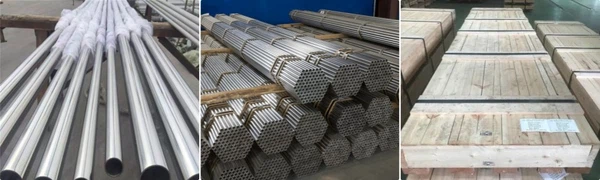
Gnee Steel GH4169 Product Packing
Contact us for the latest export price quote for GH4169 Alloy
FAQ
Q1: Does the heat treatment make the pipe harder to machine?
A: Yes, fully aged GH4169 reaches 36-44 HRC. If you require extensive secondary machining, we can supply the pipes in the Solution Treated state (approx. 20 HRC) and provide the parameters for you to perform the final aging after fabrication.
Q2: How do you ensure the weld seam doesn't corrode faster than the pipe wall?
A: Our ASME SB168 process includes a high-temperature solution anneal that homogenizes the chemical distribution across the weld. This eliminates "elemental segregation," ensuring uniform Corrosion Resistance throughout the part.
Q3: Is the SB168 welded pipe suitable for nuclear reactor internals?
A: Absolutely. When produced with VIM+VAR base material and 100% X-Ray (RT) inspection of the weld, our heat-treated pipes meet the rigorous safety and durability standards required for nuclear applications.
Q4: Do you offer bulk discounts for petrochemical refinery overhauls?
A: Yes. We are a Reliable Supplier for large-scale infrastructure projects and offer tiered Wholesale Pricing for volume orders.



